The Uneasy Lawyer and IT Dialogue

As I read two recent posts on the subject topic (Business and I.T. Must Work Together to Manage New “Web 2.0” Tools by Dennis D. McDonald and Jeremiah Owyang and The Lawyer-IT Dialogue by Simon Fodden), I realized how much of a universal challenge the relationship is – between lawyers and Information Technology (IT). Why is this relationship challenging?
Lawyers share a common context with their clients. Lawyers must be familiar with the problems and issues of their clients. On the other hand, bankruptcy & insolvency lawyers, criminalists and litigators (for example) are not, by default, knowledgeable about Information Technology in general and Web 2.0 in particular
The lack of shared context between lawyers and IT is unfortunate, because Web 2.0 trends and technologies can benefit lawyers and law firms in a number of ways.
For example, in this roundtable (from Law Practice TODAY) with Dennis Kennedy, Tom Mighell, John Tredennick, Stephen M. Nipper and Frederick L. Faulkner; a number of key web 2.0 technologies are discussed:
- What is Web 2.0
- Examples
- Wikis
- Blogs
- RSS
- Web 2.0 Applications
- What does it mean for lawyers
Aside from the technology aspects of web 2.0, there are also interesting legal issues related to blogging (a web 2.0 technology) and disintermediation consequences to the application of web 2.0 technologies to the legal profession – sometimes wrapped-up in the term “law 2.0”.
Web 2.0 matters for the legal profession, because it promotes an information environment in which lawyers can simplify access to material of precedential value. The difficulty consists in selecting and optimizing the right mix of these technologies; finding how to leverage them and especially how to carefully deploy them within an integrated information management (IM) framework.
Information Technology (IT) is just one of many enablers of IM; IM in itself being one key enabler to all knowledge-based organizations. This simple truth is often overlooked and results in the direct dialogue between lawyers and IT staff. This is problematic.
All too often, we have an unproductive corporate dialogue that looks like this:

This relationship eventually ends as follows:

Not very productive! It might be more appropriate to insert an intermediary function called “IM” between lawyers and the IT staff, giving us:
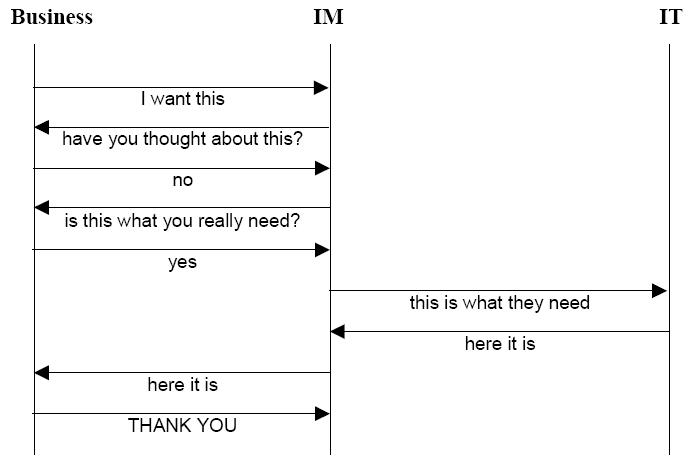
These “models” (thanks to Doug O’Brien, manager at Natural Resources Canada, for sharing his insights on topic in that simple and humoristic form) make several assumptions:
- By “IM”, we mean a corporate function that looks at Information Management holistically in which all IM facets are integrated (see Standardized IM Frameworks here), including, for example, records management, access to information & privacy, library services, research services, standards, education, training, so on and so forth;
- By “IT”, we mean a corporate function that represents the more traditional Information Technology activities, technical and “problem solving” in nature – networks, hardware and software fleet management, application development, etc.
Going back to the White Paper published by Dennis and Jeremiah, they approach the issue by asking “how should IT be involved?” The challenges they evoke (Chicken & Egg problem, Ownership Policy, Technology Trends, Employee Responsibility – on that topic see related legal issues, Crisis Management and Influence vs. Control) are all real challenges. I suggest that their paper points to a missing piece in the organizational picture: an intermediary function, or person or Department, providing the necessary interface between IT and the business. Such people know the language of the business and of IT.
In a law firm, for example, this person might be a lawyer with a strong IT background, knowledge and interest. This allows business users to remain focused on their business and IT staff to remain committed and engaged in IT problem solving without the unfair added responsibility to tackle the whole IM Problem Space.
Simon Fodden raises a similar challenge in the context of a law firm here. I wholeheartedly agree with one of his remarks:
Ideally, there might be a CIO or CKO who has the status of a partner, whether or not she/he is in fact a lawyer-partner. This person would understand both worlds enough to know what questions to ask, what issues to pose, and what policies to impose or recommend. If this truly important mediation role is left to chance, such as when it’s dependent on the fact that Mary or Ali, otherwise a librarian or an associate or an office manager, happens to have a background that facilitates things, the firm is vulnerable and may not be putting things on the best footing.
Considering law firms and lawyers thrive on information, it is well worth the investment to have a dedicated IM function and to position IT as an enabler of IM and, in turn, IM as an enabler of the business. Lawyers will find in Information Managers, as opposed to IT specialists, kindred spirits willing to explore their issues and challenges and provide advice and recommendations based on all 24 facets of Information Management as opposed to IT only.

Congratulations Patrick! You’re cited in Dennis Kennedy’s blog today.
Thanks Steven – and thanks for adding me on your list at http://vancouverlawlib.blogspot.com/2005/12/canadian-law-blogs-list_09.html – I like youridea of keeping tabs on Canadian Law related blogs.
patrick