I had a bit of a head-scratching experience just now: Google gave me a precise answer to a search that was more or less framed as a question; and I can’t recall ever seeing that before. Is this an old feature I’ve never stumbled on or is it something new that’s having a soft launch?
I usually don’t give Google a question, having learned instead to feed it a string of keywords tied in a Boolean knot. But today I asked “how many canals in amsterdam”? The first item in the results was an unequivocal answer — and not one buried in the context material — followed by the reference:
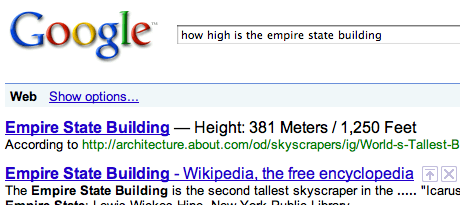
Not all “well-formed” questions evoke firm answers. And neither is it clear to me what a well-formed question requires. I proceeded with the time-honoured method of stabbing about, sometimes dignified as trial and error. I learned that there is some U.S. bias: “how high is the cn tower” failed, but “how high is the empire state building [1]” succeeded.
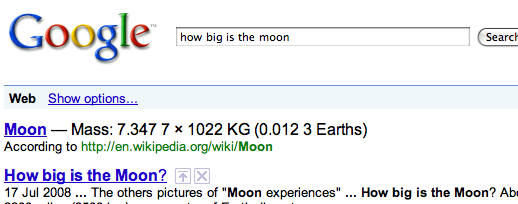
I had success with “how big is the moon [2]” and, in a segue that made sense at the time, “how big is iowa [3]“. But oddness happened when I asked the next natural question, “how big is alberta”:
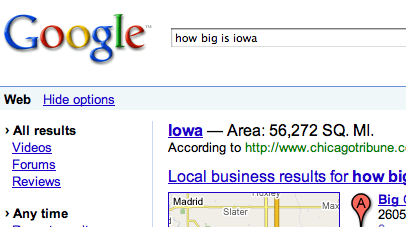
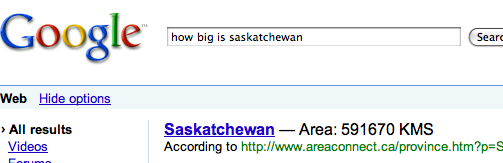
It seems that ‘alberta’ conjured up ‘AB’ which in turn evoked a Punjabi Olympic shooter [4]. So I asked the same question about Saskatchewan, figuring that there’d be small chance of confusion here (after all, as the provincial government itself says [5], “Easy to draw, hard to spell”) — and found success [6].
I made a couple of feeble attempts to force Google to cough up something definitive in the legal realm, but Google wouldn’t play along. And so for legal workers this feature, if that’s what it is, may be little more than a curiosity. (I might suggest that if Google ever learns to recognize a legal question, it provide the same answer in every case — and they can use me as the authority — “It depends”.)
We’re told that Google is anxious about Wolfram/Alpha, and so this may be part of their attempt to become a knowledge machine as well. Whatever is the case, it’s in an ill-formed state as yet, with no clear (to me) directions on what questions framed in which way will produce answers.