For anyone who knows and loves the City of Toronto, the G20 conference has been a disaster. But not all disasters are inevitable.
Kenneth Grant Crawford stated Canadian Municipal Government [1] in 1954,
It would be difficult to overemphasize the importance of the local government in the everyday life of the citizens, more especially for those who live in urban centres. That is not to say that one level of government is necessarily more important than another, for all perform functions which are essential to complete the probramme of governmental service demanded in a modern society. Yet few fully appreciate the vital part played by the local level of government…
Because many of the services of local government have been in operation throughout our lifetime, because its services have expanded gradually, nnoted by the citizen, and because those services function so efficiently, they are taken for granted as a natural condition of existence, like the air we breathe. When we turn on the tap, we assume we will get water; when we call the fire department, we expect a prompt response…and when we drive our car, we expect to find the road surface reasonably smooth and free from holes. It is only on those rare occasions when turning the switch produces no heat in the stove, when the street lights fail, or when the garbage collector neglects to call that we realize how essential to tolerable community living are the services of the local government and how bothersome is any failure in their functioning.
In the print-version of today’s Star, conspicuously absent from their website, Mayor Miller states that he found out about Regulation 233/10 [2] by reading the Star on Thursday morning (“Miller says province broke rules over G20 arrests”). He wishes the Premier had “followed the rules” in enacting the regulation to alert the public properly.
At a press conference [3] this past Thursday, he noted his suggestion to hold the conference on the CNE grounds were largely dismissed,
“I’m not going to use this podium to bash the federal government,” the Mayor continued. But he said that cities hosting similar events should have more of a voice in planning. Institutionally, he believes the federal government is set up to deal with the provinces, and is not used to negotiating directly with municipalities, even big ones.
“Right from the beginning, we need to be at the table,” he said. “That relationship has now been cemented so in the future, maybe there will be a true partnership between the national government and the city.”
There are only two levels of government under the Constitution Act, 1867 [4], and municipalities are in the exclusive jurisdiction of the province:
Subjects of exclusive Provincial Legislation [5]
92. [5] In each Province the Legislature may exclusively make Laws in relation to Matters coming within the Classes of Subjects next hereinafter enumerated; that is to say…
8. Municipal Institutions in the Province.
Justice Major emphasized this point at the SCC in Nanaimo (City) v. Rascal Trucking Ltd. [6],
31 …municipalities exercise a rather plenary set of legislative and executive powers, a role that closely mimics that of the provincial government from which they derive their existence. Yet, unlike provincial governments, municipalities do not have an independent constitutional status. (See Godbout v. Longueuil (City), 1997 CanLII 335 (S.C.C.) [7], [1997] 3 S.C.R. 844, at para. 52, and the Constitution Act, 1867, ss. 92(8) [8] and 92(16) [8].) …Municipalities essentially represent delegated government.
[emphasis added]
As affirmed by the SCC in R. v. Sharma [9], the powers exercised by municipalities are limited to those conferred by the province in statute, and those implied by express powers essential to its declared purpose.
The purpose of municipalities is stated in the Municipalities Act [10],
Purposes
2. [11] Municipalities are created by the Province of Ontario to be responsible and accountable governments with respect to matters within their jurisdiction and each municipality is given powers and duties under this Act and many other Acts for the purpose of providing good government with respect to those matters.
Section 8 [12] provides a grant of broad powers to enhance the ability of municipalities to respond to municipal issues. Part of the transfer of powers and ability to make by-laws include policing [13]under the Police Services Act [14], which establishes responsibilities to municipalities under Part I,
Police services in municipalities
4. [15](1) [15] Every municipality to which this subsection applies shall provide adequate and effective police services in accordance with its needs.
[emphasis added]
Presumably a municipality would be best informed to assess and execute the policing needs of their city, even in rather extraordinary circumstances like the G20. However, Justice Major also stated in Nanaimo,
32 …municipalities are political bodies… municipal councillors are elected to further a political platform. Neither experience nor proficiency in municipal law and municipal planning, while desirable, is required to be elected a councillor. Given the relatively broad range of issues that a municipality must address, it is unlikely that most councillors will develop such special expertise even over an extended time… council decisions are more often by-products of the local political milieu than a considered attempt to follow legal or institutional precedent. To a large extent council decisions are necessarily motivated by political considerations and not by an entirely impartial application of expertise.
[emphasis added]
Without belaboring again the mechanism through which Regulation 233/10 was enacted [16], is there a need to expand the scope of municipal powers for circumstances like this and give them formal constitutional status? A need for at least some greater deference or requirement to consider submissions from municipal authorities where civil insurrection is guaranteed to create local property damage?
This issue is explored further in an older paper by Erin Tolley and William R. Young of the Government of Canada in, Municipalities, the Constitution, and The Canadian Federal System [17]. They state in their conclusion [18],
Although constitutional recognition remains a goal, municipalities seem to have adopted a more flexible and diverse approach to the current constitutional circumstances. Perhaps this is related, in some ways, to the federal and provincial governments’ relative reluctance to re-open constitutional negotiations. As such, municipalities have chosen instead to lobby the federal government for greater fiscal support, and the provincial governments for legislative changes to the provincial-municipal relationship. However, it is not likely that calls for constitutional recognition of municipalities and guarantees of fiscal security are going to die down in the near future. Indeed, given the increasing incidences of downloading and its effects on municipalities, as well as a growing awareness of the extent of urban problems, such as crime and homelessness, it is highly probable that these calls will crescendo. However, as the size of urban centres grows and the number of urban Canadians increases, it is possible that municipal concerns will receive greater attention.
[emphasis added]
The remoteness of the decisions by other governments, especially at the Federal level for a minority government that holds no seats in the City of Toronto [19]proper, makes the interests and concerns of that political body that much more distant from the citizens of this city.
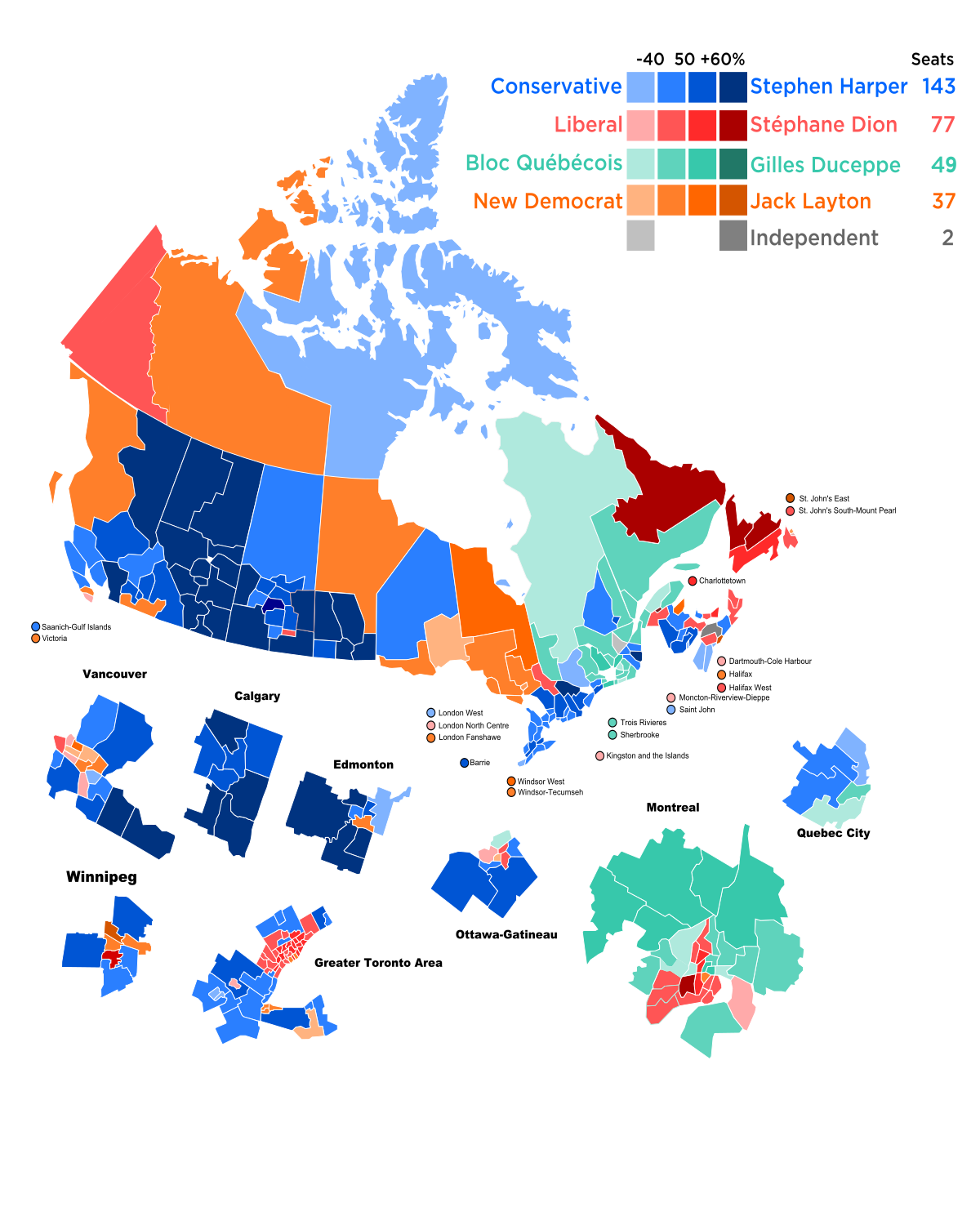
Perhaps the other way these calls will rise from a crescendo into a outright cry is if decisions made by the Federal government continue to lay waste to the streets of the cities. For the sake of those streets, let’s hope not.