

Researching Beyond the Familiar: An Interview With Professor Seánna Howard

For Professor Seánna Howard, Director of the International Human Rights Advocacy Workshop, international legal research begins with a simple but important recognition: the most valuable sources are not always the most familiar ones. Her research has taken her to Tucson, where she joined the renowned Indigenous Peoples Law and Policy (IPLP) Program at the University of Arizona College of Law. Along the way, she has worked as an advocate, lawyer, researcher, independent expert, and educator on issues involving Indigenous Peoples, international human rights law, and social justice.
Her work also reflects the importance of developing research strategies for areas of law that may not fit neatly within traditional legal databases or pre-established research methods. For researchers working with the United Nations, treaty bodies, special procedures, regional human rights systems, and Indigenous Peoples’ institutions, finding the relevant material often requires persistence, creativity, and a willingness to look beyond the sources most familiar to domestic legal researchers. As the Associate Librarian for Comparative and International Law at the University of Arizona College of Law, I have had the pleasure to work closely with Prof. Howard on several different research projects. Therefore, I invited her to share on this post her career path, research tips and preferred legal databases with all slaw readers.
Professor Howard’s path to Tucson began in Hamilton, Ontario where she was born. After completing her LLB at the University of Ottawa, she developed an interest in global justice issues, including women’s rights, children’s rights, and the history and continuing effects of colonization at both the local and international levels.
Her legal education also helped shape her understanding of the importance of learning about Indigenous rights independently. As she explained, her law school experience did not provide a dedicated focus on Indigenous rights and International Law. She therefore pursued opportunities to learn more about the historical and contemporary dimensions of Indigenous Peoples, and international human rights.
A search for programs that combined domestic and global approaches to Indigenous rights led her to the IPLP Program at the University of Arizona College of Law. Tucson was nowhere in her long-term plan. In fact, Professor Howard explained that a simple online search helped her take one of the most consequential and transformative decisions in her career path: pursuing an LLM degree at the James E. Rogers College of Law IPLP program.
At the University of Arizona, she worked with Professor James Anaya, whose expertise in Indigenous Peoples’ rights and international human rights law was instrumental in shaping her professional path. Professor Howard eventually worked on cases and matters involving international mechanisms, first as part of the program and later as a staff attorney. She took directing Professor Anaya’s International Human Rights Advocacy Workshop in 2008 and his seminar course in 2016. Her career has since continued to combine advocacy, research, teaching, and international human rights work.
Researching International Law Beyond Traditional Databases
One of the central themes of Professor Howard’s work is the need to understand where international legal information is actually located. Unlike many domestic legal researchers, international legal researchers cannot always rely on a single comprehensive database. The materials may be distributed across the websites of international organizations, treaty bodies, special procedures, specialized agencies, regional institutions, and civil society organizations. In some areas, commercial databases such as Lexis or Westlaw may provide only a partial picture—or may not provide the relevant materials at all.
As a result, international legal research often requires researchers to develop their own research maps. Professor Howard described, for example, creating charts to organize sources relating to Indigenous peoples and international human rights law. These charts bring together materials from different parts of the United Nations system and help researchers identify relationships among institutions, procedures, reports, communications, and other documents.
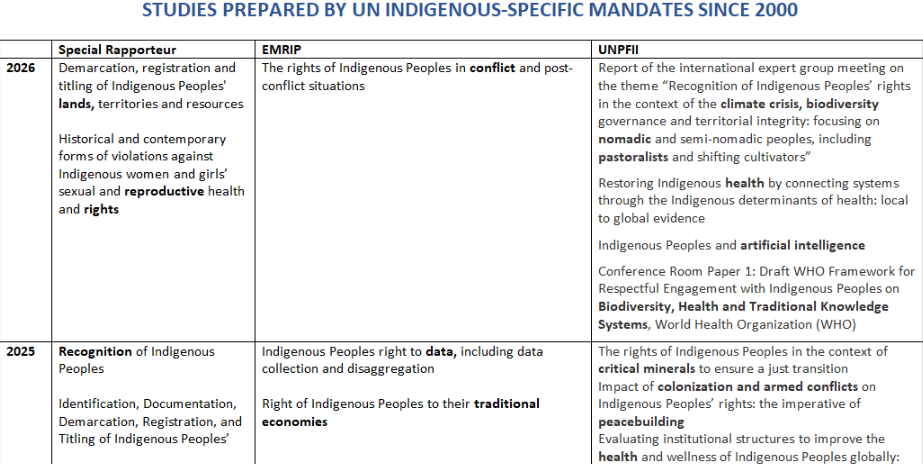
[ Click the image to see a larger version of this chart.]
Treaty Bodies, Special Procedures, and International Mechanisms
Professor Howard’s research has involved cases and statements before international mechanisms, including UN treaty bodies and the Inter-American Commission on Human Rights. This work requires a researcher to locate formal cases, decisions, communications, reports, and related materials. The sources may not always be indexed in a way that makes them easy to find through a conventional keyword search.
The same is true of the UN special procedures system. Special Rapporteurs and other independent experts produce thematic reports, country visits, communications to states, and other materials. The letters sent by special procedures to governments, for example, can be particularly important sources of information about how international human rights concerns are raised and documented.
Professor Howard has worked with databases and collections of materials relating to these communications and has provided academic support for special rapporteurs. She has also worked on reports addressing specialized human rights topics at the highest levels of the United Nations system. For students working on these projects, research can involve much more than finding a single authoritative document. It may involve compiling resources, tracing an issue through multiple international institutions, identifying relevant country-specific materials, and understanding the procedural history of a matter. The research is often investigative.
The Importance of Institutional Websites
A major part of Professor Howard’s research method is working directly with the websites of international organizations and specialized agencies. These include institutions such as the International Labour Organization, UNESCO, UNDP, and other UN-related or independent international bodies. Their websites can contain reports, decisions, policy documents, guidelines, databases, country materials, and historical documents that may not appear in commercial legal research systems.
For researchers, this means that knowing how to navigate institutional websites is an essential international legal research skill. It also means that researchers must learn the organizational structure of the institution whose materials they are using. A report from a treaty body is different from a report by a Special Rapporteur. A communication from a special procedure is different from a General Comment of a treaty body. A report of the Expert Mechanism on the Rights of Indigenous Peoples serves a different purpose from the work of the UN Permanent Forum on Indigenous Issues. Understanding these distinctions is essential for evaluating the authority, purpose, and relevance of each source.
Foreign Legal Research and International Legal Research
Professor Howard’s work also illustrates the close relationship between foreign and international legal research. As part of the legal team that brought the Maya land rights cases in Belize, she had to research its relationship to other common-law jurisdictions while also considering the country’s international legal obligations and the capacity of its legal institutions. The two types of research often go hand in hand. International law does not exist in isolation from domestic or national legal systems. Human rights standards may be incorporated into domestic law, interpreted by domestic courts, or used by lawyers to advance arguments before national tribunals.
Professor Howard emphasized the importance of understanding international law not simply as something separate from domestic law or as a set of automatically superior rules. Rather, international legal standards can become tools for advancing legal arguments and developing domestic law. Lawyers may use international standards to persuade courts to interpret domestic law consistently with human rights principles. In this way, international legal research can directly influence domestic legal advocacy. The researcher therefore needs to understand both sides of the relationship: the international source itself and the domestic legal system in which the argument will ultimately be made.
Research as Advocacy
For Professor Howard, research is closely connected to advocacy. Whether working on a case before an international body, supporting a report, assisting students, or developing resources on Indigenous peoples’ rights, legal research is ultimately connected to a concrete purpose. That purpose may be to document a violation, support an argument, identify applicable international standards, provide evidence to an international mechanism, or help lawyers develop a case before a domestic court.
This connection between research and advocacy has shaped her career from the beginning. Her path to Tucson began with an interest in global justice and a desire to work on issues that had a tangible impact. Her work with international human rights mechanisms, Indigenous peoples, students, and legal researchers has continued that commitment. It has also made her an important resource for students learning how to conduct research in areas of law where the relevant materials are dispersed across institutions and jurisdictions.
A Researcher Who Maps the International Legal Landscape
Professor Seánna Howard’s career demonstrates that international legal research requires more than familiarity with legal databases. It requires knowing how international institutions work. It requires identifying the organizations that produce relevant information. It requires understanding the differences among treaty bodies, special procedures, expert mechanisms, regional institutions, and civil society organizations. And it often requires building research tools to bring scattered information together.
Most importantly, it requires curiosity. For students and researchers working in Indigenous peoples’ rights and international human rights law, Professor Howard’s approach offers a valuable model. The best research may begin with a database search, but it rarely ends there. Sometimes the relevant source is located on the website of an international organization. Sometimes it is hidden in a treaty body document, a Special Rapporteur communication, a country report, or the work of an Indigenous organization. Sometimes the researcher must create the chart, database, or research guide that makes the information visible to others.
That combination of persistence, institutional knowledge, and creative research is at the heart of Professor Howard’s work—and provides an important introduction to the scholar and advocate who has made Daniel F. Crachiolo Law Library her intellectual home and Tucson her professional home.
Her most recent scholarship includes the following titles:
Howard, Seánna, ‘Indigenous Peoples and Regional Human Rights Systems’ (25 June 2026), in Gautham Rao (ed.), Oxford Bibliographies in Legal History (New York, NY, online edn, Oxford Academic, 25 June 2026 – )
Howard, Seánna, ‘Regional Bodies and Indigenous Peoples’ (22 Apr. 2026), in Mattias Åhrén, and others (eds), The Oxford Handbook of Indigenous Peoples and International Law (online edn, Oxford Academic, 22 May 2024 – )
Osborne, T., Cifuentes, S., Dev, L. et al. Climate justice, forests, and Indigenous Peoples: toward an alternative to REDD + for the Amazon. Climatic Change 177, 128 (2024)

Start the discussion!