Update on Ongoing Collaborative Family Law Agreement Frauds
The following is the text of the August 26 e-blast sent to Ontario lawyers reminding them of the ongoing collaborative family law cheque scam.
Almost every day LAWPRO® hears from lawyers who find themselves the targets of various kinds of frauds. While this message is not a full fraud alert, we felt we should advise lawyers to be on guard, as there has been a significant increase in the number of collaborative family law agreement frauds reported to LAWPRO over the last week. Almost 20 firms have been targeted in the last four business days. We also urge lawyers to be extra cautious as we approach Labour Day weekend, as we have seen an increase in fraud attempts around long weekends and holidays in the past.
These recent frauds have some new twists but are very similar to the collaborative family law agreement frauds we have previously warned lawyers about. See the previous fraud alert here. These frauds have been reported to the police.
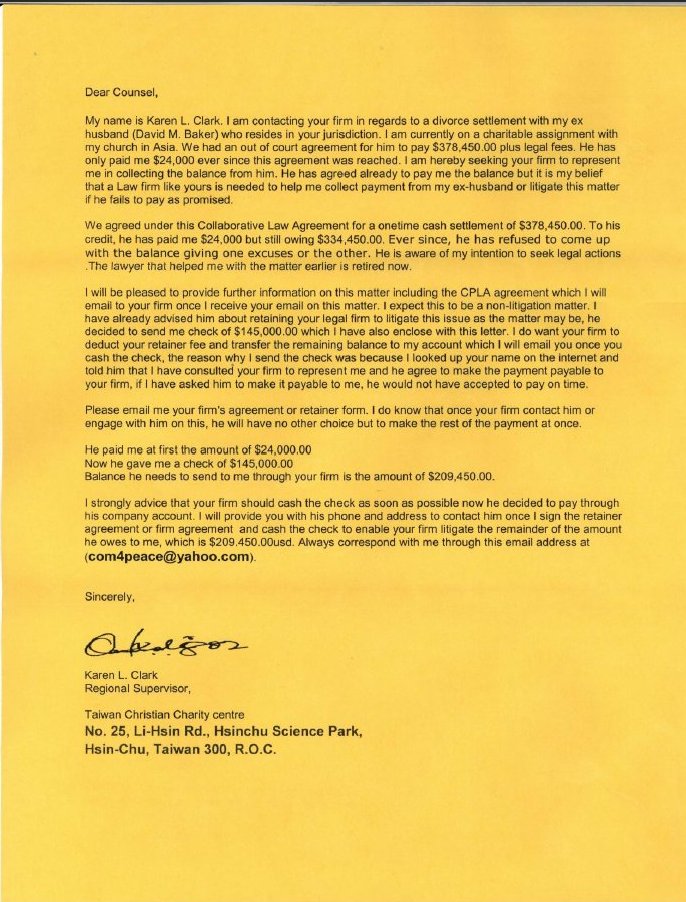
The first new twist on these frauds is that the initial contact is a letter (not an email) delivered by Canada Post. That letter is from someone claiming to be Karen L. Clark. (Click here to enlarge)

The contents of the letter are virtually identical to the contents of the initial contact email used previously (i.e., Clark and ex-husband David M. Baker have signed a collaborative family law agreement that requires a payment of spousal support by Baker).
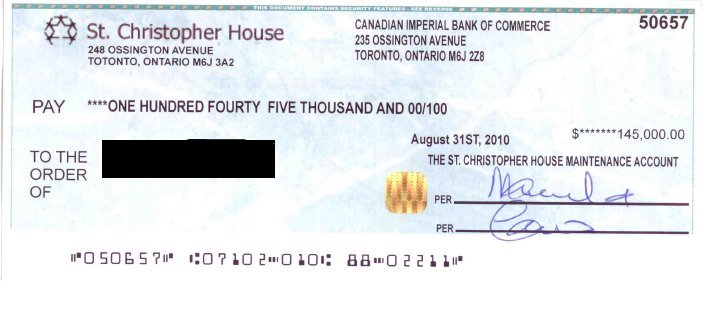
The second new twist is that each of these letters include a very real looking but counterfeit cheque or cashier’s cheque in the amount of $145,000.

(Click here to enlarge)
The counterfeit cheques appear to come from St. Christopher House and are drawn on an account at a CIBC branch on Ossington Ave. in Toronto.

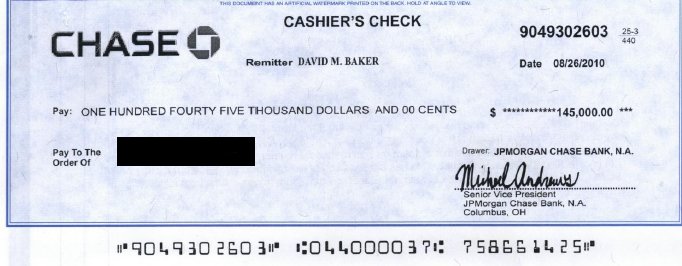
(Click here to enlarge)
The counterfeit cashier cheques appear to come from the Chase Bank. In the letter Clark indicates there is some urgency to cash the payment from Baker in case he changes his mind and urges the lawyer to take a retainer from the payment.
Please proceed with caution if you receive email messages or letters asking you to assist with the collection of spousal support arrears, or any other letter or email message that appears suspicious. Many lawyers are not replying to or acknowledging these messages when they are clearly attempted frauds. In cases where it is unclear, lawyers are replying with requests for identification and more details about the client’s current whereabouts and past circumstances of the matter, etc. They are also explicitly indicating that they will not proceed with work unless they have a signed retainer agreement and have received payment of a retainer.
Remember that the information and identification provided by the fraudster can look legitimate, but there likely will be minor inconsistencies or things that don’t add up. The fraudster’s reply usually includes a promise to pay the requested retainer. However, when the payment from the ex-husband or debtor shows up, usually a day or two later, the fraudster then says take the retainer from the payment.
If there are things that just don’t add up on a matter you are handling, ask further questions and have the client explain any inconsistencies. Does the matter make business sense? Do the terms of the contract or agreement look proper and complete? If the agreement provided to you has the names of lawyers in it, check whether they are called to the bar in the appropriate jurisdiction. This recent post on the AvoidAClaim blog has links to provincial, territorial and U.S. state lawyer licensing databases.
If you receive what appears to be a certified cheque or bank draft, contact the issuing bank to confirm that it in fact issued the cheque before you deposit it in your trust account. Even if the issuing bank confirms the cheque is legitimate, do not immediately release or wire funds to the client. Cheques sent to a U.S bank can take a week, and sometimes significantly longer, to clear.
If you have been targeted by one of these frauds, please advise Dan Pinnington (dan.pinnington@lawpro.ca) or call 416-598-5863. So that we can keep current on the types of frauds that are occurring, we would appreciate receiving copies of initial contact emails or letters and counterfeit financial instruments.
If you have been successfully duped, please immediately notify LAWPRO as there may be a claim against you.
Be on guard as holiday approaches
In the past fraudsters have been particularly active in the days before long weekends and other holidays. Presumably this is to take advantage of circumstances when lawyers and law firms staff will be busy or more distracted with other things. Please be cautious as we approach the Labour Day Holiday weekend.
Please see further information in the Keep your guard up! More sophisticated cheque scams targeting lawyers article from the May/June 2010 issue of LAWPRO Magazine. Further fraud prevention information and resources are available on the practicePRO Fraud page (www.practicepro.ca/fraud), including the , a handy reference for lawyers and law firm staff that describes the common frauds and the red flags that can help identify them. For more immediate updates on fraud and claims prevention subscribe to the email or RSS feed updates from LAWPRO’s AvoidaClaim blog.
Cross posted on Avoid A Claim

1. There is no reason to believe that this type of general warning is effective in deterring fraud. It does however give the regulator, in this case, LawPro the sense that they are “doing something”. Or as Erving Goffman wrote, some 50 years ago, the regulator plays analogous role in the con game of cooling out the mark, see:
http://www.tau.ac.il/~algazi/mat/Goffman–Cooling.htm
2. There is however a reasonable amount of science which would help pin point exactly a) which type of lawyer was at risk for this fraud, b) why they would know it was wrong and do it anyways. This is the science behind Leon Festinger’s discovery of Cognitive Dissonance, also around 50 years old.
I was one of the lawyers who received these documents. Upon receipt, I contacted Dan at Lawpro as well as the non-profit whom these cheques appeared to be coming from. I blogged about it here: http://www.aglawblog.ca/2010/08/20/frauds-against-lawyers/.
While this attempt at fraudulent activity was blatantly obvious, I think it’s important for Lawpro to educate lawyers as other attempts may be more sophisticated and not as easy to spot. I was also familiar with this type of fraud from an LSUC CLE I attended on starting a law practice. Had I not attended this CLE perhaps this fraud wouldn’t have been so clear to me, although I’m sure I wouldn’t have taken the letter very seriously.