Cats, Horses, and “Legal” Project Management

There’s been recent discussion about whether Legal Project Management is different from just regular plain ol’ project management.
It depends on how deep you want to look. Are a cat and a horse the same? They’re both mammals, right? Hair, four legs, warm-blooded…. But imagine if your sweet pet cat were the size of a horse. Her name for you would be “dinner.”
Likewise, at a superficial level Legal Project Management and traditional project management are the same. They have the same principles. They both seek to deliver work efficiently and effectively. They both are based on a combination of hard lessons learned and common sense.
But dig down just a bit, and you begin to compare cats and horses.
You might ask, does it matter? Is it just a semantic difference? Actually, I can’t imagine a lawyer saying something is “just” a semantic difference, any more than one might suggest “we’re not going” and “we’re now going” differ only in a minor way.
The difference is a lot more than semantic. LPM isn’t traditional project management wrapped in a thin coating of “legal” to make it palatable to lawyers.
The Instability of Schedules
Let’s start by looking at scheduling, a core aspect of traditional project management (which I’ll call TPM).
Consider a schedule as a two-dimensional chart. Put a timeline across the bottom. On the left side you list all of the tasks vertically; for each task, you draw a horizontal line indicating its duration, lined up with the timeline. (This picture is the basis of the Gantt chart, a vital tool in TPM.)
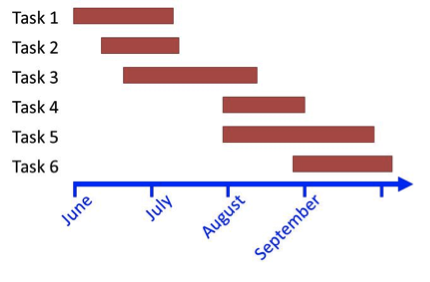
TPM starts from the assumption that a project manager can create this chart with a high degree of certainty. There may not be absolute certainty that Task 2, for example, will take 20 days, but the project manager knows the most probable duration (e.g., 20 days), knows the likely outside estimates (e.g., 19-22 days), and understands how likely the task is to be early or late.
Likewise, TPM assumes that the task list itself is knowable and fixed, that new tasks won’t appear out of the blue. The project manager may not know all of the tasks at the start of the project, but early on, before the project moves beyond the planning stage, she can nail down each of those tasks at a level of detail that allows her to control the project – i.e., more than simply “hire architect,” “pour foundation,” “build house,” and “move in.” There may be a small number of contingency tasks (“wall touch-up repainting”), but these are well understood, with known durations and probabilities.
This model works very well in many industries – construction, manufacturing, aerospace, and so on. Indeed, it would be hard to imagine significant projects in such industries succeeding without this kind of detailed and concrete project planning.
However, what happens if there is considerable doubt as to what the detailed task list really consists of (vertical instability), or as to how long those tasks will take (horizontal instability)? Suddenly, this core mapping of tasks against a timeline moves from quantitative and accurate to qualitative (at best) and indistinct. A rough picture can still be quite useful… but it is no longer a TPM planning tool.
Consider e-discovery, which is one area of legal work where project managers can to some extent apply TPM. From an LPO or outsourcer’s perspective, you can build a solid project plan, at least once you’ve sampled the documents to get an idea of how complex they are and perhaps gone through the preliminary keyword, production, and forensics battles. But that’s only part of the e-discovery picture. For the lawyer managing the case, the tasks surrounding the core EDRM activities (identification through production) are where she really earns her fee – and where both horizontal and vertical instability rear their heads. How much will the sides fight over keywords? Are backup tapes fair game? Is there disproportionate burden? Is one side using voluminous discovery as a threat rather than a truth-seeking tool?
Discovery, of course, is just a small (but expensive) part of the litigation process. Litigation tasks can be described at a summary level, but a functional project plan requires a level of horizontal and vertical detail that is rarely known in advance, especially in the kind of big-ticket litigation where cost planning and control are most needed.
Beyond Scheduling
Task and schedule planning is but one aspect where LPM and TPM differ. The goal of most litigation, for example, is not to win at trial but to reach an outcome the client is relatively happy with (or at least can live with). That could happen when the jury returns a verdict, in a 15-minute phone call between parties on day 1, or anytime in between. Even “good outcome” is a charged phrase; bad press once an action gets rolling can cost a client far more than the attendant legal fees. All of these factors must be incorporated into management of the project; TPM has little vocabulary for doing so.
In addition, corporate clients in particular can themselves add a level of instability. For one thing, the legal team often has to please a plethora of internal stakeholders with competing objectives – and who may themselves be competing to move up the corporate ladder, sometimes subtly undercutting the other stakeholders. They may delegate key tasks to subordinates who don’t have the authority to sign for a pizza and then jump into discussions to reopen apparently settled questions. They move on to other positions, to be replaced by an executive who insists on stamping his own imprimatur onto every decision (which often means undoing whatever his predecessor decided). Legal work piles project instability upon project instability; it takes specific skills rather than TPM techniques to keep these projects on the path to success.
Note that I’m not suggesting project managers trained in TPM would not be capable of handling a legal project. The principles are the same even if their manifestations differ, and good project managers tend to be more flexible and adaptive than TPM methodology would suggest. However, such project managers would succeed only by moving beyond TPM tools and techniques.
Is Legal “Special”?
Some writers have suggested that Legal Project Management needs the “Legal” prefix only so that lawyers will accept it. Indeed, there is a perception in many quarters that “Legal is special,” that everything in the legal world must be bespoke.
The world of commercial and IT software development, for example, has a very similar set of problems: horizontal and vertical task/schedule instability, multiple stakeholders, shifting goals, the corporate client-go-round. (Goals may be controllable in version 7 of some software solutions, but early versions are generally exploratory; they have a broad set of sometimes conflicting goals and a certainty that you won’t achieve all of them, at least not if you want to release the solution in the current decade. There are exceptions such as avionics systems, but those exceptions exist in environments far more controlled and controllable than commercial software or IT solutions.)
Some of the worst project management I’ve seen in my 35 years of managing people and projects has been in the software industry, where inflexible project managers have attempted to force TPM techniques onto their fluid surroundings. Indeed, one of my fears around Legal Project Management implementations is that IT will attempt to bring TPM to bear on the Legal world. I’ve worked with a few outstanding IT and commercial software project managers – but they steered clear of trying to force the round TPM pegs into the solution’s square holes. They succeeded by applying the approaches of “Legal” Project Management to their environment.
There are some aspects of LPM that are truly specific to the legal world, just as there are some aspects of TPM that apply exclusively to construction projects. Overall, though, it’s not that Legal is “special” per se, but rather than TPM tools and techniques are ill-adapted to the legal world.
There’s a lot more in play than semantics. The success of your projects depends on leaders – whether trained project managers or simply smart attorneys with common sense and good planning skills – who not only understand the differences but take a non-TPM approach that makes sense for the legal world.

Steven,
Great analogy. Thanks for keeping the conversation going on this topic.
Toby