Canada’s online legal magazine.

Archive for October, 2012

Online Display Advertising Grows Up

Online display ads (a.k.a. “banner ads”) have been seen for most of their short existence as a kind of marketing table scrap of the modern age, an unloved byproduct created alongside the explosive growth of websites. It took about a day (circa 1997 or so) for the initial novelty to wear off of seeing something whirring or flashing on the corner of your screen while you were trying to read an article, after which banner ads simply became part of the online landscape that we grudgingly learned to live with. Their value in the marketplace limped along accordingly. Frequently, publications . . . [more]

Posted in: Legal Marketing

Social Media Security Basics [Infographic]

We all should do more to protect our social media accounts from being compromised. On an almost daily basis you hear about a celebrity that has had their account or smartphone hacked – and no doubt – there are thousands of otherwise anonymous non-celebrities that suffer the same fate each and every day.
So what can you do to protect yourself? Yes, a stronger password is a start, but there is a lot more you can do. A ReadWriteWeb post I came across today has a fantastic infographic that does a great job of explaining the basics of social media . . . [more]

Posted in: Technology: Internet

Happy Thanksgiving

It’s Thanksgiving Day, so we’ll be light on entries — but heavy on eating — today.

But before the feasting begins I wanted to say “thank you” to everyone who reads Slaw. We’re grateful that you take the time to see what we have to say.

And if you have a moment to spare, read a bit about what may have been the first thanksgiving ceremony performed by Europeans on North American soil, here in Canada in 1578. . . . [more]

Posted in: Administration of Slaw

Maytree Review of Immigration Reform

The Maytree Foundation has just released a report by Naomi Alboim and Karen Cohl, Shaping the future: Canada’s rapidly changing immigration policies. The report reviews the immigration reforms between 2008-2012, the pace and scope of which are unprecedented in Canada, according to the authors.

The vast majority of these changes impact Canada negatively, the authors claim. Some of the most problematic changes include:

  • conditional permanent residence for spouses and entrepreneurs
  • treating refugees differently based on country of origin
  • more difficult citizenship procedures
  • a focus on short-term labour market needs, rather than long-term nation building
  • inconsistent policies which lack predictability
. . . [more]
Posted in: Substantive Law

Canadian University Websites Breached, Records Exposed

The New York Times has a story about hackers who have broken into servers at 53 universities and have published online certain student records and other data.

The universities concerned are principally in the United States but include some in other countries. Two Canadian universities have had their servers hacked: the University of British Columbia and McMaster University.

I’ve followed up the hyperlinks provided and find that data from both these universities is openly available online at the time of writing. . . . [more]

Posted in: Miscellaneous

R v. Mabior; R v. DC

This is a guest post by Carissima Mathen, who is an Associate Professor in the Faculty of Law at the University of Ottawa.

Having done an initial pass of the Supreme Court decisions issued today, my main sentiment is….admiration (not least, for the unanimous opinion). I think the Supreme Court has done its utmost to consider all sides, even if I don’t necessarily agree with everything it said.

First, some background. The Mabior 2012 SCC 47 and DC 2012 SCC 48 appeals presented the Court’s first opportunity since 1998 to consider the difficult issue of how the law should . . . [more]

Posted in: Case Comment

‘Do Not Track’ Command on Browsers: On or Off by Default?

Microsoft has announced that its new Internet Explorer 10 browser will block the tracking of users’ browsing records by advertisers. There will be a ‘do not track’ command that will be turned on by default, though users can turn it off.

According to this Outlaw.com story, the American Association of National Advertisers has complained about this. Tracking, it says, allows for advertising better targeted to users’ interests, thus more likely to be effective, thus more lucrative for the advertisers, thus providing more money to support the ‘free’ content on the Internet. Blocking tracking by default ‘takes the information out . . . [more]

Posted in: Substantive Law, Technology: Internet, ulc_ecomm_list

The Friday Fillip: Jeans

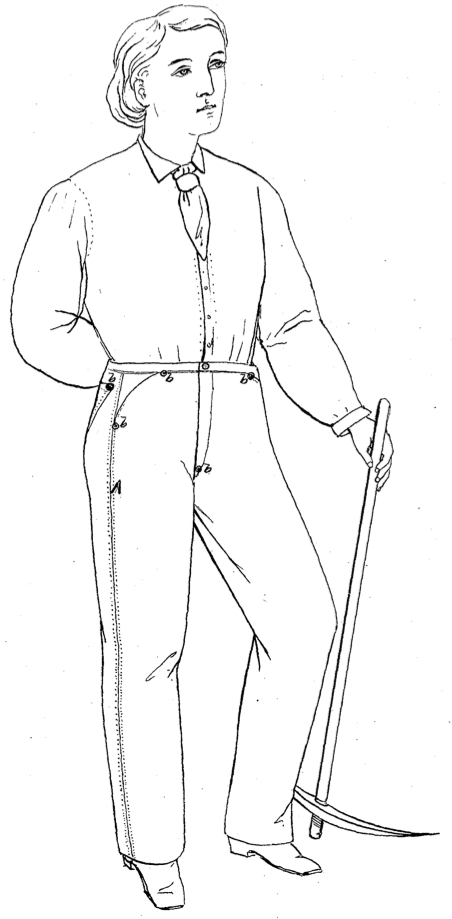
Who is this dapper fellow, you might ask? He’s a California gold miner, and he’s sporting one of the first pairs of Levi Strauss’s serge de Nîmes pants. What makes them special, apart from the fact they’re made of denim, is the use of rivets at the critical joints, an invention that Strauss’s partner, Jacob Davis, patented in 1873. The image is from that patent application, as is the following:

My invention relates to a fastening for pocket-openings, whereby the sewed seams are prevented from ripping or starting from frequent pressure or strain thereon; and it consists in the

. . . [more]
Posted in: Miscellaneous

Five Steps for Extra Security

Most lawyers and law firms know what they should be doing to maintain a secure computing environment in order to comply with ethics rules regarding confidentiality, as well as data breach notification laws. This list includes maintaining firewalls and up-to-date anti-virus and anti-malware, maintaining vigilance when opening attachments and surfing the Internet, using strong and different passwords for each important login, scrutinizing the security protocols of cloud providers, maintaining adequate backup files, and keeping operating systems patched. However, there are still reports almost daily of companies – and even law firms – experience breaches. What else can be done to . . . [more]

Posted in: Legal Technology

You Might Like … to Glance at Greeks, Savage, Turbo, METZ, Bysshe, Eno and More

This is a post in a series appearing each Friday, setting out some articles, videos, podcasts and the like that contributors at Slaw are enjoying and that you might find interesting. The articles tend to be longer than blog posts and shorter than books, just right for that stolen half hour on the weekend. It’s also likely that most of them won’t be about law — just right for etc.

Please let us have your recommendations for what we and our readers might like.

. . . [more]
Posted in: Miscellaneous, Reading: You might like...

Solomonic Judging?

[Broken record on]

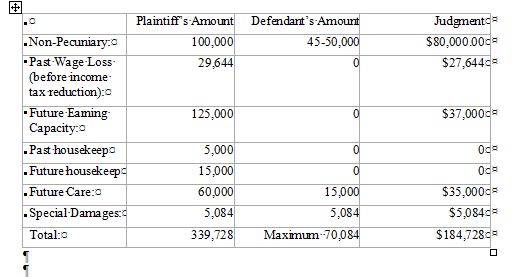
Smith v. Moshrefzadeh, 2012 BCSC 1458  is a motor vehicle [accident], personal injury action. Liability was admitted. The issue was how much.

The chart shows what the the plaintiff claimed, the defence position, and the award.

This is what the trial said the law was that determined whether the defendant’s negligence was a cause.

 [59] The primary test to be applied in determining causation is commonly articulated as the “but for” test: a defendant will be fully liable for the harm suffered by a plaintiff, even if other causal factors were at play, so long as

. . . [more]
Posted in: Substantive Law: Judicial Decisions

3li_EnFr_Wordmark_W

This project has been made possible in part by the Government of Canada | Ce projet a été rendu possible en partie grâce au gouvernement du Canada