

Consciously Competent: A State of Mind for Supporting Student Learning

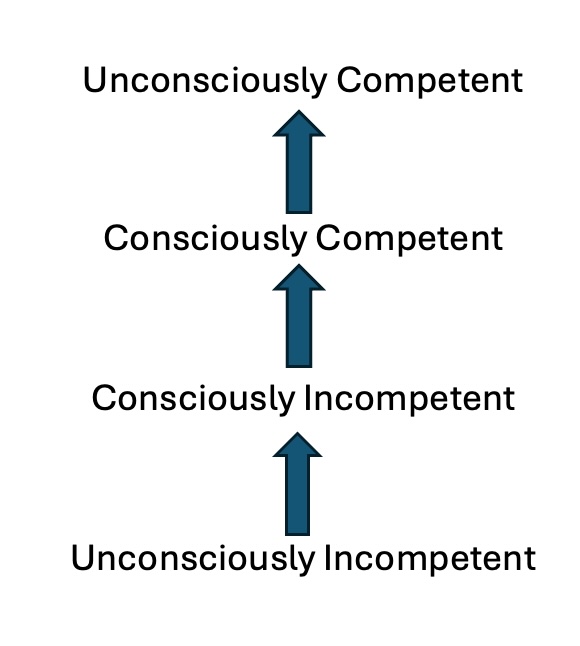
Early in my career in education, I was introduced to a learning scale that offered both my students and me a different way of thinking about competency. The scale looks like this:
Understanding the Competency Continuum
Let’s consider this through a real-world example: learning to drive a car.
Before you begin learning to drive, you have little understanding of either the process itself or the rules of the road. At that stage, you are unconsciously incompetent. You do not yet know what you do not know.
As you begin to learn, however, you quickly realize how much there is to understand—from road signs and right-of-way rules to the operation of the vehicle itself. At this point, you become consciously incompetent.
With practice, you begin to assemble the steps involved in completing different actions. You recognize that a stop sign means stopping the car, and that stopping requires a sequence of actions: taking your foot off the gas, applying the brake, slowing to a full stop, and, if turning, activating the signal. At this stage, you are consciously competent.
After driving for some time, these actions become second nature. You no longer think deliberately about each individual step involved in slowing down, stopping, or signaling a turn. You have become unconsciously competent.
Apply the Framework to Student Learning
What does this have to do with supporting student learning?
First, it requires understanding where we are as educators. Have we become so practiced at a task that we no longer consciously think about the individual steps required to complete it? If so, we may struggle to effectively convey those steps to students.
The best educators and mentors remain consciously competent. They can articulate the process, break a task into its component parts, and explain not simply what needs to be done, but how to do it. This supports students by helping them truly understand what is involved in producing quality work.
The next step is identifying where our students are.
Are they completely unfamiliar with the task—that is, unconsciously incompetent? If so, asking them to complete the task without sufficient guidance will often result in low-quality work, frustration, and uncertainty. Students at this stage may lack even the foundational knowledge necessary to know what questions to ask or where to begin.
At this point, it is essential to provide the background knowledge they need, along with clear directions about both what is expected and how to approach the task.
Do students have some background knowledge related to the assigned work? If so, they may be consciously incompetent.
This can be a particularly difficult stage for students. They are now aware of what they do not know, which can create uncertainty, anxiety, and a loss of confidence. At this stage, it is important to acknowledge those feelings and provide meaningful support by answering questions—even when the answers may seem obvious to us—and by exercising patience.
With time, direction, and constructive feedback, students at this stage can work their way toward becoming consciously competent.
Setting Expectations Along the Learning Journey
This also leads directly to the importance of expectation setting.
Particularly when students are learning new skills, they need to understand that learning is a process and that the path is not identical for everyone. Students benefit from being able to identify where they are on their own learning journey and from recognizing that reaching the stage of unconscious competence can take years.
At the same time, they should appreciate the value of remaining consciously competent—occupying a space in which they continue to see the steps involved and can share that knowledge with others.
Teaching with Intentional Competence
Successful educators must guard against becoming unconsciously competent.
To fully support student learning, they must strive to remain consciously competent: able to identify and articulate the steps involved in a task, recognize where students are in their development, and respond in a way that supports growth at each stage.
Ultimately, building student success is, in many ways, a state of mind.

Comments are closed.