

The Friday Fillip

A meditation of sorts, today, on forgetting, re-membering, progress, civilization and all the small stuff like that. But fear not: I won’t be blathering on about these imponderables: I’ll do my best to let you consider them.
The material on which to meditate is a hoard of art work — at least, that’s how we might see it now — produced by what has come to be known as Old Europe. Around seven thousand years ago, in an area about the Danube River, groups of people settled, lived, worked, played and made artefacts for something like a millennium and a half. The, to me, astonishing thing about this hive of otherwise perfectly ordinary human activity is the quality of the artefacts they left behind.
New York University’s Institute for the Study of the Ancient World is sponsoring an exhibit on The Lost World of Old Europe, which you can visit online. But you might like to start with the New York Times piece on the exhibit, which summarizes things nicely. Both site have great pictures of the artefacts I’ve mentioned.
Let me give you merely a small sense here, by showing you two images — click on the thumbnail below to see a somewhat enlarged version:
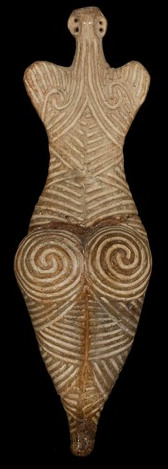
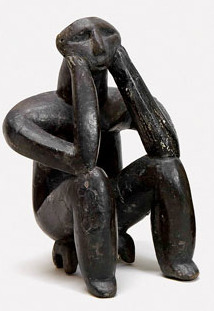
These images of a woman and “a thinker” might appear in a modern art gallery downtown today, which shows progress to be a vexed matter at least. They make me realize, too, how easy it is for cultures to vanish and for their accomplishments and skills to be forgotten. But what took me aback was a statement in the material I’ve pointed you to that made it clear this was not yet a “civilization.” These people had no writing and didn’t use the wheel, or so we now believe. And perhaps, too, they had no cities — hence an absence of “civil” society.
Only, look at the images made available in connection with this exhibit, imagine what manner of people made them, and perhaps for a moment consider what all the big words might mean.

Comments are closed.