Canada’s online legal magazine.

Archive for ‘Substantive Law’

CRTC Publishes Guidelines for Anti-Spam Regulations

Nearly two years ago — a lifetime on the internet — Royal Assent was given to Canada’s anti-spam law (otherwise known as An Act to promote the efficiency and adaptability of the Canadian economy by regulating certain activities that discourage reliance on electronic means of carrying out commercial activities, and to amend the Canadian Radio-television and Telecommunications Commission Act, the Competition Act, the Personal Information Protection and Electronic Documents Act and the Telecommunications Act, S.C. 2010, c. 23. The CRTC was given power to make regulations under the Act, which it has done, although they have not yet . . . [more]

Posted in: Substantive Law: Legislation

Are ‘Hacking Back’ and Other Cybersecurity Defences Acceptable?

If you could detect an attack on your computer system and defend against it, would you want to do it? should you be allowed to do it? What if defending meant harming the computer of the attacker? What if defending meant at least getting information about intermediate computers between the attacker’s and yours?

There are legal and ethical questions here. A review of the ethical ones appears in Stewart Baker’s blog, Skating on Stilts. (He is a former General Counsel of the US National Security Agency, among other high-level achievements.)

Mr Baker argues for private defence as well as . . . [more]

Posted in: Substantive Law, Technology: Internet, ulc_ecomm_list

Jonathan Band’s Google Books Litigation Infographic

The various lawsuits by authors, publishers, and photographers against the Google Library Project since 2004 have been commented here on Slaw repeatedly by several different contributors.

Jonathan Band recently developed an infographic to help depict the various developments, and is available for download here.

The Google Books Litigation Family Tree . . . [more]

Posted in: Substantive Law: Foreign Law

Strategic Maple Syrup

I’m sure that many of you noticed a brief flash in the news recently regarding Quebec’s strategic maple syrup reserve and the security issues surrounding said reserve. There were many tongue in cheek references to Maple Syrup’s place in the culture of Quebec and Canada in the media and then the news cycle moved on. Alas, we here at Slaw dig deeper and try to ascertain the legal angle to such events, and it seems that Maple Syrup does indeed occupy a significant place in Canadian culture.

A rudimentary CanLII search reveals that “Maple Syrup” has appeared in court cases . . . [more]

Posted in: Substantive Law: Judicial Decisions, Substantive Law: Legislation

What Is Hadopi? and Why Does It Matter?

Yesterday, my partner Anne-Sylvie Vassenaix-Paxton gave a talk to ALAI Canada (L’Association Littéraire et Artistique Internationale) on the impact the new French HADOPI laws no. 1 and 2, have had on peer to peer file sharing and protection of personal data under French law.

The acronym stands for the Haute Autorité pour la Diffusion des Oeuvres et la Protection des Droits sur Internet (HADOPI), a body which co-ordinates a variety of legal measures against illegal downloading including sanctions against parents of downloaders.

Two points are interesting from a North American perspective. The French Constitutional Council threw out a draft of . . . [more]

Posted in: Substantive Law: Foreign Law, Substantive Law: Legislation, Technology: Internet

HathiTrust Win “Transformative”

Virtual delight echoed in tweets, posts, and emails in my corner of the web late Wednesday, upon the release of Judge Baer’s opinion in Authors Guild, Inc. v. HathiTrust 11 CV 6351 (S.D.N.Y.). Very shortly after its release, Prof. James Grimmelmann posted the opinion on Scribd.

Briefly, for those unfamiliar, the plaintiffs and defendants had each sought summary judgment in respect of the plaintiffs’ copyright infringement claim. HathiTrust and related university defendants saw near-entire success in their summary judgment motions, failing only on a standing question not consequential to the result. The outcome: Fair use protects the defendants’ participation . . . [more]

Posted in: Case Comment, Legal Information: Libraries & Research, Substantive Law: Judicial Decisions, Technology: Internet

A Trade: Shares for Rights?

UK online newspapers and blogs are buzzing with the proposal outlined by George Osborne, a British Conservative politician and Chancellor of the Exchequer, at the Tory conference yesterday: in exchange for shares given by their employer, newly hired employees would have to give up certain employment rights (see here for The Guardian article). Under this program, employees would be able to waive certain rights with regard to unfair dismissal, redundancy, flexible work time and receive rights of ownership. This employment-ownership scheme would see a large deregulation of the labour market and encourage start-up companies that are concerned with all the . . . [more]

Posted in: Miscellaneous, Practice of Law: Future of Practice, Substantive Law: Judicial Decisions

Maytree Review of Immigration Reform

The Maytree Foundation has just released a report by Naomi Alboim and Karen Cohl, Shaping the future: Canada’s rapidly changing immigration policies. The report reviews the immigration reforms between 2008-2012, the pace and scope of which are unprecedented in Canada, according to the authors.

The vast majority of these changes impact Canada negatively, the authors claim. Some of the most problematic changes include:

  • conditional permanent residence for spouses and entrepreneurs
  • treating refugees differently based on country of origin
  • more difficult citizenship procedures
  • a focus on short-term labour market needs, rather than long-term nation building
  • inconsistent policies which lack predictability
. . . [more]
Posted in: Substantive Law

‘Do Not Track’ Command on Browsers: On or Off by Default?

Microsoft has announced that its new Internet Explorer 10 browser will block the tracking of users’ browsing records by advertisers. There will be a ‘do not track’ command that will be turned on by default, though users can turn it off.

According to this Outlaw.com story, the American Association of National Advertisers has complained about this. Tracking, it says, allows for advertising better targeted to users’ interests, thus more likely to be effective, thus more lucrative for the advertisers, thus providing more money to support the ‘free’ content on the Internet. Blocking tracking by default ‘takes the information out . . . [more]

Posted in: Substantive Law, Technology: Internet, ulc_ecomm_list

Solomonic Judging?

[Broken record on]

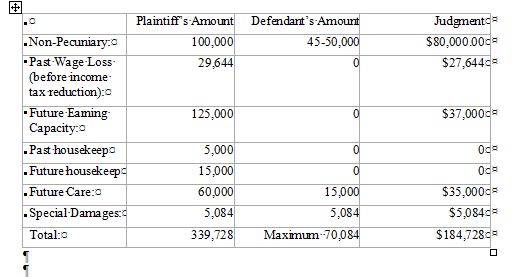
Smith v. Moshrefzadeh, 2012 BCSC 1458  is a motor vehicle [accident], personal injury action. Liability was admitted. The issue was how much.

The chart shows what the the plaintiff claimed, the defence position, and the award.

This is what the trial said the law was that determined whether the defendant’s negligence was a cause.

 [59] The primary test to be applied in determining causation is commonly articulated as the “but for” test: a defendant will be fully liable for the harm suffered by a plaintiff, even if other causal factors were at play, so long as

. . . [more]
Posted in: Substantive Law: Judicial Decisions

Occupational Health and Safety Administrative Penalties and the Defence of Due Diligence

A recent case from Nova Scotia raises some interesting points around the defence of due diligence in administrative penalty cases for health and safety cases.
Posted in: Case Comment, Substantive Law, Substantive Law: Judicial Decisions

Gender Equality Litigation – Who’s Counting?

This morning’s Globe and Mail features a prominent advertisement for Queen’s University:

The bold statement is hard to miss:

But is it quite true? To get a definitive answer we will need to wait for Kerri Froc‘s book. She is writing the first comprehensive examination of its history, interpretation and potential application with the goal of ensuring the Charter delivers on its promise of a fair, equal and democratic society for all Canadians.

In the interim, we can argue about why cases like M. v. H., 1999 CanLII 686 (SCC), [1999] 2 SCR 3, won by Martha . . . [more]

Posted in: Legal Information, Substantive Law: Judicial Decisions

3li_EnFr_Wordmark_W

This project has been made possible in part by the Government of Canada | Ce projet a été rendu possible en partie grâce au gouvernement du Canada