Williams
Bills that have introduced in Canada and Nova Scotia


On Friday Adobe announced two new products that demonstrate the company is increasingly embracing cloud-based technologies.
The first product, Adobe SendNow, allows you to send large files to a single or multiple recipients. While this is not a new concept, Adobe adds several features that provide value to lawyers. SendNow allows you to set expiry times for how long a document will be available for download, and allows you to confirm that a document has been viewed by the recipient.
The second product, Adobe CreatePDF, is a cloud-based version of Adobe Acrobat that allows you to convert a . . . [more]
Most of us outside Saskatchewan put our clocks back an hour yesterday, and we’ve now returned to what some might call “God’s time”. Of course, when it comes to the o’clock, it’s actually the law that disposes, and the law’s been setting our watches backwards and forwards for just over a hundred years. At the beginning of the last century, the English builder, William Willet, found a champion in Parliament to get his scheme passed for recapturing “some of the hours of wasted sunlight in the spring, summer, and autumn.”
Perhaps fearing that a jump of a full . . . [more]
My computer will never be the same again. If you click on any program and select the About option (often on the Help menu), you can see what version of the program you have. Google Chrome tells me I’m at 8.0.552.0. But part of me is convinced that if I check back in an hour or so, that number will have gone up, or at least gotten longer. The pace of incremental change to my software applications and operating systems is accelerating. My computer is on a hamster wheel. And these minor changes, happening behind the scenes, can have an . . . [more]
Interpol has released its orange alert report for hidden explosives, which details the features and components of Improvised Explosive Devices (IEDs) originating in San’a, Yemen. Interpol has released the information to assist law enforcement in identifying suspicious packages.
The entire 4-page report can be downloaded here (pdf).
Two packages containing printers with Pentaerythritol tetranitrate (PETN) secreted on the inside were separately identified in UAE and the UK heading for synagogues Chicago.
One of the synagogues reports high web traffic to their site from Cairo, Egypt immediately preceding the incident.
In an unfortunate twist of irony, Sana’a, Yemen was once . . . [more]
McCracken v. Canadian National Railway Company, 2010 ONSC 6026 (Ont SCJ) is necessary reading for any member of the legal profession with any (relevant) involvement in class actions. . . . [more]
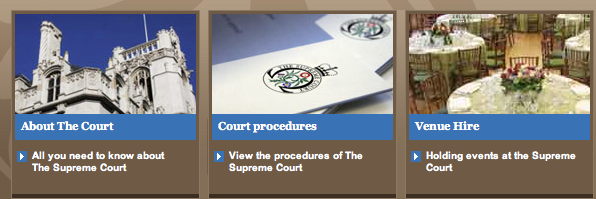
I visited the website of the new UK Supreme Court (UKSuC?) recently — it’s a good-looking site, better, in my estimation than the new US Supreme Court site and, alas, our own — but I have to confess I was shocked to see what amounts to a real estate ad front and nearly centre on the home page. Three images are featured in boxes leading to important content. The one on the right is an advert for the renting of the Supreme Court building as a venue for events:
The text at the other end of . . . [more]
Smart Matt Mullenweg. He’s the founder of Automattic, which runs WordPress.com and supports WordPress.org (whose publishing program makes Slaw possible). One of his recent ventures is FoodPress, an aggregator of the best foodie blogging on WordPress.com. It’s got great content—at no real cost. Smart, as I said.
The content is worth a look, if you’re at all involved with food beyond simply eating to live. As with a lot of food porn on the internet, much at FoodPress depends on the quality of the photographs (there’s even a Favorite Food Photo Archive). That strawberry has to glow; the roast . . . [more]
1. Following the example of the UN Model Law on Electronic Commerce, the UN E-Communications Convention [PDF] contains a provision on when electronic messages are received. They are received when they are capable of being retrieved by the addressee at an electronic address designated by the addressee. (Article 10) An electronic message is presumed to be capable of being retrieved by the addressee when it reaches the addressee’s electronic address.
The explanatory note to the Convention explains at para 180 that this presumption of retrievability may be rebutted, for example, if the security filters of the addressee’s system prevent the . . . [more]
I’ve got three bits of IT to pass along today.
1. The first should be evident from the typeface you’re reading this in. It’s called Josefin Sans Standard Light. And I offer it to you not so much for your reading pleasure — I wouldn’t choose it as a text face — but to catch your eye. Because, though you may never have paid attention, the web for most of its life has been anchored to those few typefaces we all share thanks to Microsoft and Apple, the commonest being Arial and some variant of Times New Roman.
Because typefaces . . . [more]

This project has been made possible in part by the Government of Canada | Ce projet a été rendu possible en partie grâce au gouvernement du Canada