

Responsive Design: AC’s Approach to an Emergent Measure of Access to Justice
More and more people are seeking that access to justice efforts be people-centred: They should be designed around people’s needs, culturally aware and responsive. This can mean legal and other services being co-designed with those who will use them. It can also mean organizations collaborating across sectors, rather than expecting individuals to navigate disconnected systems.
Such ambitions are also reflected in international frameworks. In Making Justice Systems More Effective and People Centred, a 2025 report by the Organisation for Economic Co-operation and Development (OECD), they call for justice pathways that respond to people’s circumstances, including through cross-boundary and multidisciplinary collaboration. The OECD’s related work on measuring people-centred justice raises a key question: How will we know whether justice systems are becoming more responsive?
Amici Curiae Friendship Society (AC) offers a place to begin answering that question. For AC, responsiveness (often by avoiding an overly prescriptive approach) is not simply a feature of a service, it is a way of working and a culture. Intentionally meeting with old friends to ask them what their justice gaps are matters, because needs change over time.
For me, I still prefer pounding the pavement to meet with others, my well-worn shoes will attest to that.
On our road trip to Kamloops last September, an immigration service provider who has been referring clients to us for four years now, shared their challenge: The Federal government keeps changing the rules for migrant workers. Without missing a beat, they felt comfortable enough to say: “Are you able to …. And while you are at it, would you consider helping us with …..”
Our unscheduled visit to two Indigenous community groups during our visit yielded the same type of requests. I am sure that we would not have had such rich conversations and shared justice challenges over Zoom.
Travelling 800 kilometres to hear service providers tell us in person matters.
We note there is a tension between the responsive approach and the traditional hands off practice. In the face of rapid technological, social and environmental change and complexity and in accordance with trauma-informed practice principles, we increasingly say legal professionals should be culturally aware, support agency, apply strengths-based approaches and be open to co-design. Nevertheless, we observe that institutions reward distance, predictability, formal boundaries, carefully managed risk and tidy outputs. These practices and associated habits may have developed out of legitimate purposes such as fairness, accountability, consistency and integrity. However, when they become a default response, they make it harder to address issues in the “grey areas” where barriers take shape as well as to support clients where they are at, in the present moment.
Our founding board chair, Justice Groves, likes to remind me that AC was born in 2011, during a time when desk order divorce applications from temporary foreign workers were being rejected, and AC had to fashion a novel approach to make these applications more likely to succeed. We know grey.
So, if the legal sector’s ways of working haven’t changed as much as our language has, how do we get there?
Applying responsive design starts with curiosity: What is happening for people in this community? Who already understands the problem? What are we missing? It creates connections across roles and institutions. It looks for something useful that can be tried now, while remaining willing to learn and adapt.
Crucially, it involves the willingness to take risks.
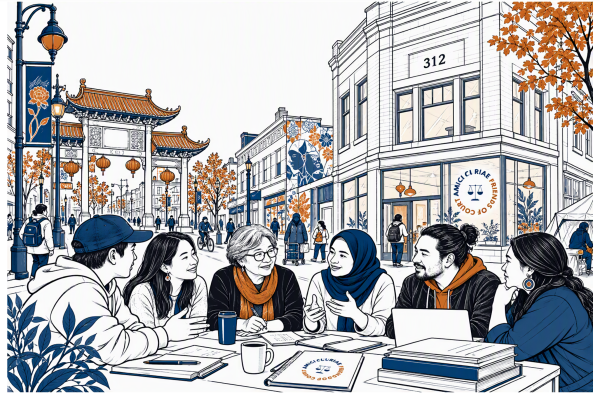
AC’s work with community organizations in Vancouver’s Chinatown and Downtown Eastside illustrates this approach. Rather than assume what people needed, AC engaged with organizations already supporting communities navigating the legal system. That is why AC hosted its first Pan-Asian Community of Practice in November 2025, and subsequently published the Pan-Asian Justice Report. This engagement helped surface practical needs, which led to opportunities for service providers to exchange knowledge, strengthen referral pathways and learn from one another.
We also recognize something that generic service design can overlook: There is no generic person at the centre of the justice system. People encounter legal problems through particular languages, cultures, citizenship status or migration circumstances, family relationships and life experiences that involve other sectors and institutions. A response that works for one community may not work for another. Responsiveness, therefore, requires more than translating information or adding an advisory group. It requires sustained relationships with people and organizations whose knowledge is rooted in those communities. We know that many like-minded organizations are already working tirelessly to address and dismantle barriers to justice faced by the community, but many expressed the need for time and opportunity to build relationships with other organizations to create collaborative synergies instead of working in silos, competing for resources, and experiencing burnout.
From the outside, this way of working can look messy. The next step may emerge through a conversation; a referral relationship may develop before a formal program exists; a small connection may lead to an opportunity nobody anticipated. But this kind of messiness is not evidence of a lack of forethought or organization. In a complex system, it is often evidence that people are truly listening, connecting the dots and actively responding.
Indeed, relationships matter when they change what becomes possible to achieve equity. When information travels between organizations, referrals can become more customised and useful. When a community’s experiences reach those who are part of one or more institutional structures, an unmet need can receive a shared, practical response.
The referral pathway developed with the Immigration Refugee Legal Clinic, Migrant Workers Centre, and AC is evidence of a relationship becoming a tangible access point. To strike a referral system, we met months after the Community of Practice. We expect the system to become operational in early 2027.
AC’s relationship with the Migrant Workers Centre was forged in 2011. These days, we have a volunteer embedded in their Saturday legal clinic that allows us to understand the justice gaps of their clients, particularly those who are working without immigration status, under a closed work permit, or under a vulnerable worker open work permit. Where appropriate, our volunteer books them an appointment for our services. On the spot.
What, then, should we measure? Not only the number of people served, referrals made or sessions delivered. Those outputs matter, but they do not tell the whole story. We may want to ask whether or not individuals had a smooth connection to suitable resources; whether or not organizations are able to provide sufficient and appropriate supports; whether or not societal and community-based knowledge is actively integrated into and enhances institutional structures; and whether or not the system learns and adapts when its existing approaches fall short. These are not soft measures. These are measures of system capacity: The capacity to notice, reflect and respond to improve access to justice.
AC’s experience shows that a focus on relationships and a willingness to do things differently make effective responses possible. Given that responsiveness has become a defining feature of people-centred justice, we suggest that one of the most important measurement questions is, “When someone tells us the system is not working for them, how capable are we of changing what happens next?” Ultimately, this requires not only better frameworks, but also greater institutional and human willingness to be curious, connected and creative.
We are hosting our second Community of Practice in February 2027, you’re invited to come be part of our conversation.

Start the discussion!