November 27, 2009
Simon
Fodden
The Friday Fillip
by Simon Fodden
November 27, 2009
Since today seems to be a quiz Friday, here’s an easy one to kick off this Friday Fillip. Who is this debonaire man?
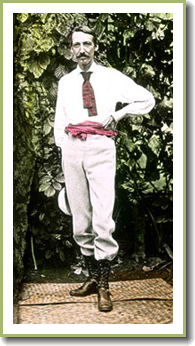
The Scot, Robert Louis Stevenson, or RLS as he’s known by aficionados, has a substantial website all to himself, known, unsurprisingly as the Robert Louis Stevenson Website. Here you’ll find photographs of the man (and boy), because Stevenson, of course, who lived from 1850 to 1894, was born during the first years of widespread public photography. You’ll learn that, like Samuel Pepys, he tootled on the flageolet — no, not that flageolet — and actually composed some works for it. And you can see the route he took in his travels through Europe, the United States (and not Canada), and across the Pacific to the South Seas, where he died.
Most of all, of course, you can read about his writing. He is famous for The Strange Case of Dr Jekyll and Mr Hyde, Kidnapped, and Treasure Island, which for me was his best, with its tale of “fifteen men on the dead man’s chest,” Long John Silver, Captain Flint, and the dreadful Blind Pew with his tap-tap-tapping. If you haven’t read these — or haven’t re-read them recently — you might want to do so in the virtual books provided on the site, turn-the-page photographs of actual first editions. Or you might prefer to let Librivox read them to you as you sit in traffic, ready to daydream (J&H, K, TI).
But RLS wrote in just about every genre that there was — essays, travel writing, short stories, poetry — perhaps you were read to from A Child’s Garden of Verses — plays and biography, as well as thirteen novels and romances.
There’s a lot more on the site about this passionate man who fought with Samoans for freedom from colonial rule; who married “an independent American woman” in Paris, separated from her husband and two children; and who trained in his youth for lighthouse engineering and also studied law. Bounce around the RLS site for fun or scan the really helpful site map if you’re interested in something particular. Let yourself get carried away.
Since today seems to be a quiz Friday, here’s an easy one to kick off this Friday Fillip. Who is this debonaire man?

The Scot, Robert Louis Stevenson, or RLS as he’s known by aficionados, has a substantial website all to himself, known, unsurprisingly as the Robert Louis Stevenson Website. Here you’ll find photographs of the man (and boy), because Stevenson, of course, who lived from 1850 to 1894, was born during the first years of widespread public photography. You’ll learn that, like Samuel Pepys, he tootled on the flageolet — no, not that flageolet — and actually composed some works for it. And you can see the route he took in his travels through Europe, the United States (and not Canada), and across the Pacific to the South Seas, where he died.
Most of all, of course, you can read about his writing. He is famous for The Strange Case of Dr Jekyll and Mr Hyde, Kidnapped, and Treasure Island, which for me was his best, with its tale of “fifteen men on the dead man’s chest,” Long John Silver, Captain Flint, and the dreadful Blind Pew with his tap-tap-tapping. If you haven’t read these — or haven’t re-read them recently — you might want to do so in the virtual books provided on the site, turn-the-page photographs of actual first editions. Or you might prefer to let Librivox read them to you as you sit in traffic, ready to daydream (J&H, K, TI).
But RLS wrote in just about every genre that there was — essays, travel writing, short stories, poetry — perhaps you were read to from A Child’s Garden of Verses — plays and biography, as well as thirteen novels and romances.
There’s a lot more on the site about this passionate man who fought with Samoans for freedom from colonial rule; who married “an independent American woman” in Paris, separated from her husband and two children; and who trained in his youth for lighthouse engineering and also studied law. Bounce around the RLS site for fun or scan the really helpful site map if you’re interested in something particular. Let yourself get carried away.
Respond: make a comment | read the 1 comment
Share: Email | Save as PDF | Print
| Bookmark & Share
More: in Miscellaneous | from Simon Fodden

Make a comment:
Note that some comments may be moderated. If you have not had an approved comment here before, your comment will be held for approval. We are glad to publish comments that address issues raised in the post or other comments on it and that contribute to a fruitful discussion. We do not publish comments that seek to promote commercial products or that seek personal legal advice.
Although we do not require it, we ask that in making a comment you use your full name. You must supply a valid email address, which will not appear with your comment.
|
the count:
6106 pages & posts | 8404 comments
 ... a per saltum project from Slaw ...
Our simple-to-remember rewriting of the URL for the Supreme Court of Canada — And lessupremes.ca works as well, bien sûr.

Gavel Busters It's time to bring the hammer down on Canadian sites that mistakenly use the gavel as a symbol of law. Help us wipe out this scourge! Learn more on our Gavel Busters page.

The Friday Fillip Collections
Some end-of-week frivols fastened in folios for your enjoyment ...
Selected Fillips from 2006 2007 [2008 2009 coming soon ... ]

Slawstalgia See how things used to be on Slaw: - the page from June 5, 2006, when we'd be going for just about a year... - the page from May 13, 2010 [PDF], nearly four years later...
-
Currently the Web largely uses IPv4, Internet Protocol version 4. Each IPv4 address is limited to a 32-bit number, which means there are a maximum of just over 4 billion unique addresses. IPv6 is the next generation Internet Protocol and uses a 128-bit address, so it supports a vastly larger number of unique addresses. Enough, in fact, to give every person on the planet over 4 billion addresses!
-
Paul Ceglia sued Facebook and Zuckerberg in state court June 30, claiming that an April 2003 contract entitles him to ownership of most of the closely held company. Ceglia’s lawyer produced a copy of the document for U.S. District Judge Richard Arcara today at a hearing in federal court in Buffalo, New York.
-
-
"click here to sign out forever" Nice
-
From blogs to Twitter to Facebook, companies and firms are leveraging the power of social networking as a business tool. A look at Canadian business use of social networking.
-
‘I was trying to keep the criminals out,’ police chief says there never was a five-metre arrest rule.
-
Police dealing with G20 demonstrators can use sonic cannons for crowd control, but with restrictions, Superior Court of Justice Mr. David Brown ruled this morning, reports The Star's Peter Edwards.
But he ruled Toronto police can only use the noise blasters at the lower decibel range. Ontario Provincial Police still have the discretion to use the cannons at both the lower and highest decibel settings, the judge said, because their guidelines for use are more cautious. That means the OPP can't come right up to someone and blast them.
The justice stressed that the OPP were not permitted to use the cannons at random. "Their use requires very serious authorization," he said. Crowd safety would benefit from police having a quick and effective means of communicating with protesters, he said.
-
"Just 10% of Twitter users generate more than 90% of the content, a Harvard study of 300,000 users found."
-
"Technology experts and stakeholders say they expect they will ‘live mostly in the cloud’ in 2020 and not on the desktop, working mostly through cyberspace-based applications accessed through networked devices. This will substantially advance mobile connectivity through smartphones and other internet appliances. Many say there will be a cloud-desktop hybrid. Still, cloud computing has many difficult hurdles to overcome, including concerns tied to the availability of broadband spectrum, the ability of diverse systems to work together, security, privacy, and quality of service."
-
. . . interesting article . . . about a researcher who is looking into technology or methods to allow personal data to "fade" over time.
|
Surprised that readers haven’t tumbled to the Canadian connection here, which is that in Scotland the Stevenson family was famous as the great innovators in lighthouse design, and that Stevenson designed lights were recycled to Newfoundland where they can be seen to this day at Cape Bonavista, Rose Blanche and Ferryland
Slaw readers may be captivated by the Seward prosecution for duck hunting on lighthouse property, which reads like something out of the 1928 Rockbound by Frank Parker Day [yes I know that's Nova Scotia].
And here’s a picture of the Cape Bonavista light designed by RLS’ father and uncle.