

Research and Serendipity

Taking up on my colleague Laurel Murdoch’s post at the end of my Day of Destruction thread last week, she said that “the process of research… affects the final result”.
We talk occasionally about serendipity, the intersction of apparent chance on the research process. On Friday, Laurel asked whether I knew of any cases which dealt with the phenomenon of a court deciding an issue on grounds or citing caselaw completely different from what counsel had argued.

 A brief reflection and a couple of calls to our Slaw colleague Eric Gertner (l) and John Swan (r), which led me to statements in Cronk v. Canadian General Insurance Co.
Before taking new matters into account based on statistics which have not been considered in the judgment under appeal, the adversarial process requires that the court ensure that the parties are given an opportunity to deal with the new information by making further submissions, oral or written, and allowing, if requested, fresh material in response.
and Semelhago v. Paramadevan
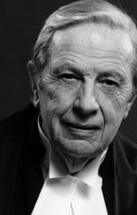 What does this have to do with serendipity? There is a lovely story that when the late John Robinette (in the 1970s to mid-Eighties, Canada’s finest civil litigator) did research, he always read the case before and the case after the one that he was immediately interested in. He said that countless times, he would discover that it would be relevant to other cases.
I also told Laurel about Lord Denning who said that he learned most of his law editing Smith’s Leading Cases, and would use the law he found there at later stages. Does anyone actually think that it was counsel that contrived the doctrine of promissory estoppel and then offered it up to Denning J. in the High Trees
A Google search turned up the Guardian obituary, which contains the serendipitous quote that completes the circle.
In 1929 Denning produced an edition of Smith’s Leading Cases which is a collector’s item. His compendious memory for law never deserted him; in judgment after judgment he would refer to authorities which counsel had not produced, sometimes predicating his decision on them. It led to some rancour on occasions, partly because it meant that cases were being decided on unargued points, but partly also because the cases he cited tended not to support the propositons for which he invoked them. The result was always more important to him than how he got there.

Comments are closed.