

The Friday Fillip

This is Good Friday for Christians, those at least who use the Gregorian calendar. And this post is about using that calendar and a formula in order to calculate when Good Friday and Easter should be celebrated each year. To make it more than simply topical, let me point out that this calculation has been known since the middle ages as “computus,” which seems right for those of use who use “computers.”
…And for those of us who are drawn to (I do not say “revel in”) complexity. Because at the heart of “computus” you’ll find “epact,” which is the measure of the difference between the lunar and solar years, the former being 354 days and the latter 365, of course — except when it’s not, and then it’s 366. Excess days, epacts, gather at 11 a go, as the years progress until the epact is equal to or greater than thirty, whereupon an embolismic month is inserted into the lunar calenadar, reducing the epact by 30. But wait, there’s more. After 19 years of this, the epact has to be corrected by a day (saltus lunae) in order for the 19 year cycle to repeat.
See what I mean about complexity? To understand how truly… computational it is, take a look at the Wikipedia article on the topic, which contains tables and charts and formulae enough to satisfy even the most mathematically inclined among you.
My own cheat is to reckon that Easter comes on the first Sunday on or after the first full moon after the vernal equinox (i.e. March 20 or 21, depending). Apparently this isn’t accurate because the real rule hinges on something known as an “ecclesiastical full moon” and treats the equinox as fixed on March 21. Understandably, the ecclesiastical full moon (the 14th day of the new moon) fails to take into account the subtleties of lunar motion and so… wanders a bit. As a result, Easter was “off” by a month in 1962. I think.
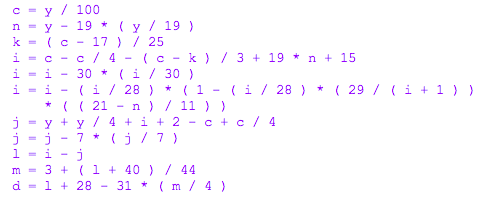
But try it for yourself. The following is a modern algorithm found on the U.S. Navy Observatory site. You are warned that this is an “integer” calculation, in which all remainders from division are dropped (and thus 7 divided by 3 equals 2).

Comments are closed.