

The Friday Fillip

I’ve got the brain on, well, the brain today. It’s partly, I suppose, because of the news of Senator Kennedy’s illness. Partly, too, because of a set of book reviews I’m reading in Harper’s, “A Mind of Its Own, Resisting the tyranny of the brain” by Gary Greenberg. And of course I, like you, spend a good deal of time each day with my electronic brain, a.k.a. my computer. So the brain it is, today.
First, wonder. We hear all too often how AI is going to duplicate our thinking abilities, how as the internet grows ever larger an intelligent singularity will come into existence — how, in short, the right person with the right set of tools will be able to fashion a being almost as good as the one your mother made. Oh yeah? Check out these (meat) brain stats: There are about 100 billion neurons in your head — something like the number of stars in the Milky Way; and where neurons connect there’s a synapse, of which there are about 500 trillion; and the number of circuits, therefore, along which signals can pass is, to quote the Harper’s piece, “hyper-astronomical”: maybe 10 followed by a million zeros. And all of that is just you, alone.
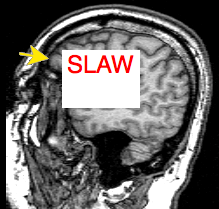 If you want your head to know more about your head, you could consult Brain Explorer, a Lundbeck Institute site that offers you a brain atlas, with pictures and explanations. Or go to the Harvard Whole Brain Atlas, where you’ll find nifto cross sections of the think stuff done by PET scans and you can locate your amygdala from above, the side and the front.
It’s taken a while for neuroscience to get here. Hippocrates guessed right about the brain — at least, in part. “Men ought to know that from nothing else but thence [from the brain] come joys, delights, laughter and sports, and sorrows, griefs, despondency, and lamentations… I am of opinion that the brain exercises the greatest power in the man… It is the brain which is the messenger to the understanding.” Now there are studies that figure out which parts “light up” when we laugh, count, lie, etc. etc. If these and other studies interest you, you can read Zach Lynch’s blog, Brain Waves, where he reports on the discoveries as they occur. Or you can let PBS do all the work and follow along online on their Secret Life of the Brain.
Even that might be too much earnestness. So I’ve got some brain teasers for you. (“Can you find a quick and elegant way to add the numbers from 1 to 30 ?”) And what would a fillip be without games? So try GWAP, which stands for “games with a purpose,” the purpose being, in this case, to help teach a Carnegie Mellon electronic brain to become just a little bit more like you.
Wha’d’ya think?

Comments are closed.