

The Friday Fillip

What goes “ninu ni ni no ni no“?
Give up?
Answer: a siren in Catalan. Yup, that’s the noise that a cop car makes in certain parts of Spain. Same car, though, goes “pin pon,” if it’s in France and “wang wang wang” if it’s hurrying through the Philippines. This is onomatopoeia, folks, which lovely long Greek word means the making of words from sounds.
It’s always fascinated me that using the same aural apparatus folks can come up with such different-seeming words for the same aural stimulus. The Wikipedia article on Cross-linguistic onomatopoeias has dozens and dozens of examples in areas such as wind blowing (svish, jhir jhir . . .), a creaking door (knarz, vrrzzz . . . ), and kissing (cmok, umma . . . ).
This, of course, can be serious stuff. Linguists and semioticians want to know how this variation comes into being. One researcher, Reuven Tsur, offers online his paper on onomatopoeia and “the constraints of semiotic systems” — too technical for a fillip (and, certainly, for me), except for a lovely, homely illustration:
There is a parable by Izmailov about the cuckoo who tells her neighbours in the province about the wonderful song of the nightingale she heard in a far-away country. She learned this song, and is willing to reproduce it for the benefit of her neighbours. They all are eager to hear that marvellous song, so the cuckoo starts singing: “kukuk, kukuk, kukuk”. The moral of the parable is that that’s what happens to bad translators of poetry. The thesis of this paper is that Izmailov does an injustice to the cuckoo (not to some translators). When you translate from one semiotic system to another, you are constrained by the options of the target system. The cuckoo had no choice but to use cuckoo-language for the translation. The question is whether she utilized those options of cuckoo-language that are nearest to the nightingale’s song.
Of course, Tsur surrounds this with expert analysis, charts, and waveforms; but the point is clearly made.
For the most part, we use onomatopoeia without being aware of it, having absorbed into the language those creations from times past — the word “cuckoo” being a good example. Some others: click, zip, buzz, beep, squeal, flutter, whinny, murmur, creak, jangle, whisper, mumble, howl, gush.
More subtly, poets, who deal in sounded language, often make use of onomatopoeia. “I heard the ripple washing in the reeds / And the wild water lapping on the crag”; “… the moan of doves in immemorial elms / And murmuring of innumerable bees.”
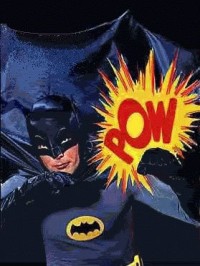 And then, of course, there are comics. What would they be without those lovely verbalized sounds? Such as kolin!, bum!, plof!, brekk!, gaan! . . .

Comments are closed.