

Dyson Loses at English Court of Appeal

There’s an old saying among lawyers (and law profs) that claims “you can’t suck and blow at the same time.” But it would seem that inventor Sir James Dyson is managing to expel steam from his ears even while his vacuum cleaners continue to inhale a decent share of the “hoover” market. The reason for his turbulence is that his share has been somewhat lessened in Britain thanks to a recent decision of the court of appeal for England and Wales. In Dyson Ltd v Vax Ltd [2011] EWCA Civ 1206 the court decided not to overturn a trial judgment that Vax’s Mach Zen C-91 MZ vacuum cleaner did not infringe Dyson’s registered design.
The language around which the issue was argued comes from (EU) Designs Directive 98/71:
… A design shall be protected by a design right to the extent that it is new and has individual character…
A design shall be considered to have individual character if the overall impression it produces on the informed user differs from the overall impression produced on such a user by any design which has been made available to the public before the date of filing of the application for registration or, if priority is claimed, the date of priority
In assessing individual character, the degree of freedom of the designer in developing the design shall be taken into consideration.
…A design right shall not subsist in features of appearance of a product which are solely dictated by its technical function…
The scope of the protection conferred by a design right shall include any design which does not produce on the informed user a different overall impression.
In assessing the scope of protection, the degree of freedom of the designer in developing his design shall be taken into consideration.
The court of appeal found no error in the trial judge’s conclusion that an “informed user” would find significant differences in the designs of the two machines. Indeed, Sir Robin Jacob, writing the first judgment, said he would have come to the same conclusion:
An informed user looking at the two designs would indeed notice the difference between them because the overall impressions are different: “smooth curving and elegant” versus “rugged angular and industrial.” These are different designs
I find it interesting that in assessing similarities and differences, the court hears argument as to particular features and puts itself in the position of the “informed user” to make the judgment, much, I suppose, as it would when the standard is the “reasonable person.” Yet a conclusion under the latter standard is, of course, a policy statement in some measure as to appropriate social conduct; whereas, the former standard seems to me, at least, to invite—indeed, beg for—actual evidence from actual informed users. I’d be interested to learn whether any of the judges used the machines in question, handled them, saw them in various settings, etc. My guess is not. There’s something… funny (both “peculiar” and “ha ha”) about a Lord Justice Jackson and a Lady Justice Black opining on a tool that they’d be better off asking their charlady about.
But in case you’d like to venture an opinion yourself, expert or inexpert, you can consult a number of photographs of the two machines in similar poses at the end of the appeal judgment, only two of which are reproduced here (the Dyson is on the left; click on an image to enlarge it):
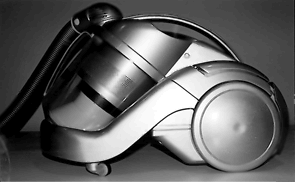
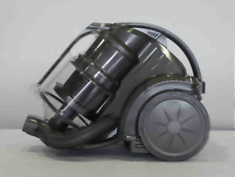
And the steam coming out of Sir James’s ears? Dyson had won a case in France against the same Chinese-owned company with respect to the same machine. He’s quoted as saying after the court of appeal judgment:
[I]t is galling and mind-boggling. There is something very off when we get support from the French courts but not from the British. We need to better protect British design.

Comments are closed.