

The Friday Fillip: The Paucity of Choice

Because I use computers a lot and tend to have more than a few of them, I get asked from time to time to help a friend choose which computer to buy. Should she spring for more RAM? Should he pick this brand? And because there are perhaps half a dozen or more features in play, each of which can have a number of modulations, the “perms and coms” are large and much anxiety can ensue, even after I point out that the differences between package A and package B are so small that either would be just fine. The same agony of dithering can occur with any choice, of course.
It’s a commonplace now that consumers are offered too much choice. Barry Schwarz’s popular Paradox of Choice had as its thesis that, crudely put, too much choice makes us unhappy. And where better to see that plethora (a negative word, note) than at the supermarket. Here’s Schwarz:
A typical supermarket carries more than 30,000 items. That’s a lot to choose from. And more than 20,000 new products hit the shelves every year, almost all of them doomed to failure…. Who but a professor doing research would even stop to consider that there are almost 300 different cookie options to choose among?
Ah, to live in simpler times! When, so we’re told, the flow of information was somehow much much less, and the choices confronting us were, well, sensibly few.
Recently, watching a TV show on Edwardian farming, I learned to my surprise that there were then more than 300 varieties of apples grown for making “scrumpy.” We’re not talking about mere cookies here, people. These are apples destined for alcoholic cider, than which few fates are more noble. And, moreover, apples grown in one small part (the Westcountry) of a very small country.
It occurred to me then that there might not be enough information flowing in to my ken about choice and variety in times gone by. Sure enough: a bit of research unearthed, so to speak, the truth about the paucity of choice — concerning our food, at least. Yes, we can opt for asparagus in winter — unnatural though that seems to me, still. But how many potatoes, tomatoes, or carrots can you choose from?
Here’s a chart from a relatively recent article in National Geographic that demonstrates graphically how we’ve had our world radically narrowed for us (at the same time as we’re being told that we’ve never had it so good). And narrowed with respect to what we ingest, mind you. It shows the radical decline in the number of seed varieties made available to growers between 1903 and 1983. You’ll have to click on it to make it large enough to read, but even in it’s shrunken state you can see the outlines: where once there were 408 varieties of pea, there are now 25.
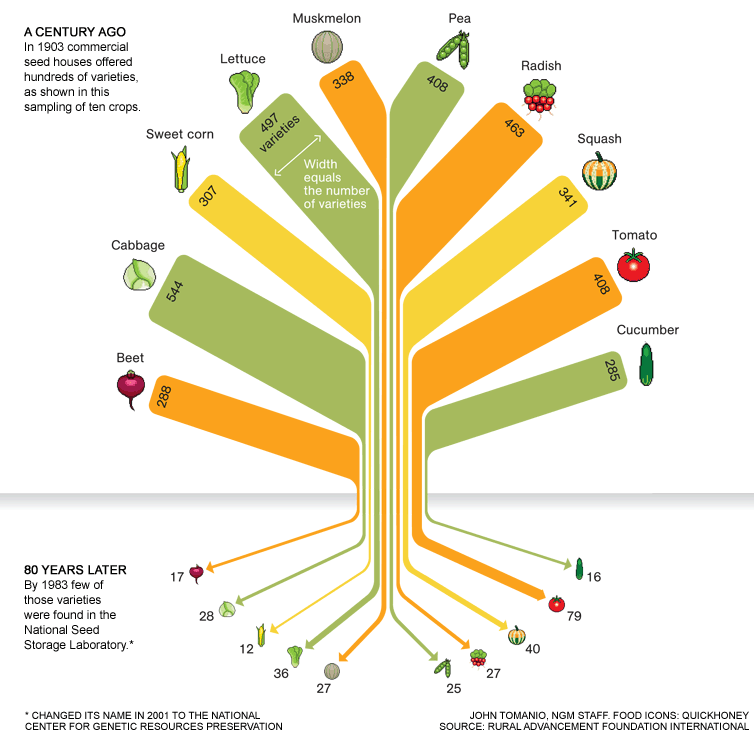
Click on image to enlarge.

It should also be noted that it is this very lack of diversity that makes our entire food supply more vulnerable to pestilence and disease. It also radically limits the horizons of what is available. It’s like a world of tall, blond, blue-eyed, athletes. And we all know where that excellent idea came from and where it ended.