

Thursday Thinkpiece: Adam Dodek’s Constitutional Challengers: The Heroes, Villains, and Crusaders Behind Canada’s Biggest Cases

Periodically on Thursdays, we present a significant excerpt, usually from a recently published book or journal article. In every case the proper permissions have been obtained. If you are a publisher who would like to participate in this feature, please let us know via the site’s contact form.
Constitutional Challengers: The Heroes, Villains, and Crusaders Behind Canada’s Biggest Cases
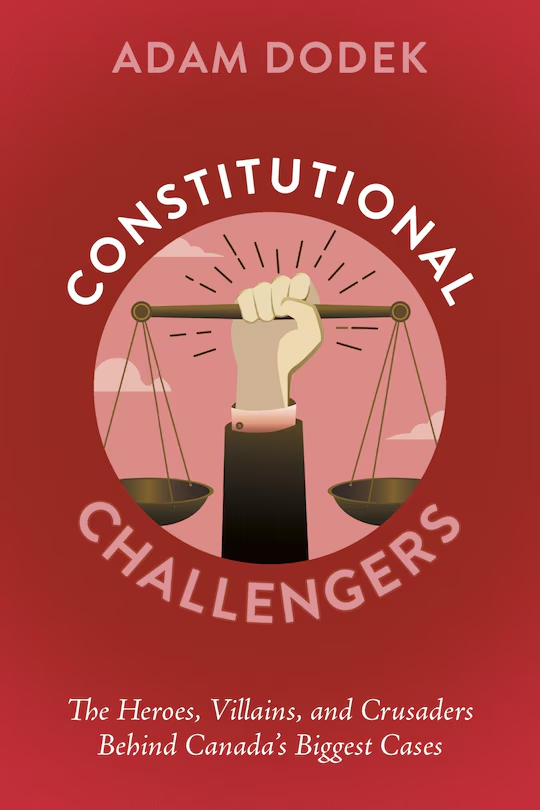 Author: Adam Dodek with Sean Cousins, Yasmeen Atassi, Sébastien Cyr, Asha Sahota, Marna Swart, Jamie Bell, Bionca Chu, and Dominique Charland
Publisher: Dundurn Press
Publication Date: January, 2026
Shipping dimensions: 9″ H x 6″ W x 1″ L
ISBN:9781459755222
288 pages, 6 x 9
Paperback | $26.99
People Matter
The Supreme Court decides big constitutional issues that directly impact the lives of Canadians: Do Canadians have the right to assisted suicide? What rights does a person have when they are arrested on criminal charges? Do women have the right to an abortion? Can the government outlaw hate speech or child pornography? It also decides issues of broader principle that indirectly affect Canadians: Are government officials — including premiers and the prime minister — subject to the law? How far does freedom of religion or the freedom to protest go?
Some of these landmark decisions are well-known to some Canadians, but most are not. Even less well-known are the people behind these historic cases that changed the lives of Canadians. . . . Some of the people involved in these monumental decisions are heroes, others are villains, a determined few are crusaders, and many are unlikely passengers.
Heroes, Villains, Crusaders (and Passengers)
. . .
Of course, whether someone is a hero or a villain is a matter of perspective. Prime ministers are often embraced as heroes by some and disdained as villains by others. The labels also change with time and historical perspective. The same applies to groups. In the 1930s and 1940s, a small group of Jehovah’s Witnesses were seen as villains by many in Quebec. Others saw them as an unpopular religious minority that was being unfairly targeted. Today, many see them as heroes for championing civil liberties and freedom of religion against an authoritarian state.
Some heroes or villains are crusaders: people who campaign for a cause and set out to change other people’s views and make broader social change. Dr. Henry Morgentaler was a crusader for abortion rights. James Keegstra was on a crusade to impart his antisemitic views to his students. Terri-Jean Bedford was a crusader for the rights of sex workers, and Harry Daniels was a crusader for Métis rights. These people devoted significant portions of their time or their lives to a cause bigger than themselves.
But most of the people behind landmark legal decisions are not crusaders. I call them passengers because they were carried along by our legal system, often all the way to the Supreme Court. They weren’t championing a cause; they were just trying to achieve a result for themselves that ended up being much bigger than themselves. They were along for the ride — often a long and convoluted one — in the Canadian justice system.
There are different types of passengers. Some people get caught up in the criminal justice system, having been arrested on a criminal charge, and all they want to do is stop the car and get out, however they can. They aren’t trying to change the world, just to get out of trouble. Many of the biggest criminal decisions featured passengers as protagonists. Other passengers were using the justice system as a way to get what they needed or wanted: to become a lawyer as a non-citizen in Canada (Mark Andrews); to wear a kirpan to school (Gurbaj Singh Multani); or to get married to a same-sex partner (Michael Leshner and Michael Stark).
All of these people are part of the Canadian constitutional story. Readers will reach their own conclusions whether these constitutional challengers are heroes or villains.
Overview of This Book
Constitutional Challengers is divided into three parts. Part I tells the stories of several cases that contributed to the making of our Constitution. Some, like Roncarelli v. Duplessis (1959), are celebrated as great wins for big constitutional principles like the rule of law. But as you will read in chapter 3, the person at the centre of this case — Montreal restaurateur Frank Roncarelli — lost a lot along the way. Other cases, like Bliss, are considered losses and are not widely known, even in legal circles. But the determination of Stella Bliss in bringing her case all the way to the Supreme Court paved the way for the constitutional protection of equality rights in the Canadian Charter of Rights and Freedoms in 1982.
Part II includes cases under the Canadian Charter of Rights and Freedoms. Some of these featured high-profile personalities like abortion crusader Henry Morgentaler, child pornographer Robin Sharpe, and Canada’s most famous dominatrix, sex worker Terri-Jean Bedford. Others, high-profile as they were, had protagonists who were not well-known, though their last names may be: David Oakes, the most famous name in Canadian constitutional law, and Elijah Askov, whose name became synonymous with delays in our criminal justice system. Other protagonists achieved brief notoriety during their cases but returned to lives of relative obscurity: Chantale Daigle captured the interest of the media when she fought an injunction obtained by her ex-boyfriend to prevent her from having an abortion; Delwin Vriend became a lightning rod for social debate over gay rights when he was fired from his job in Alberta for being gay and the Supreme Court ruled in his favour. In almost all of these cases, the rule of law established by the Supreme Court lives on, but knowledge of the people involved has faded.
Part III tells the stories of people and nations who fought for constitutional recognition of Indigenous rights. There was little mention of Indigenous Peoples in our Constitution before 1982. In the British North America Act, 1867 (now the Constitution Act, 1867), the federal Parliament was given the power to make laws for “Indians and lands reserved for Indians.” Until 1982, therefore, Indigenous persons, nations, and communities were constitutional objects, treated as persons or groups to be regulated. With the enactment of the Constitution Act, 1982, they became constitutional actors. The new Constitution recognized “Aboriginal Rights” in section 35, and it allowed the participation of Indigenous leaders in certain discussions on amending the Constitution. This part tells the stories of Indigenous activists, like Donald Marshall Jr. and Harry Daniels, who fought for the rights of their communities, the Mi’kmaq and Métis. It includes the story of the Tŝilhqot’in, who never relinquished their claim to their land and who succeeded in obtaining the first declaration of Aboriginal title under section 35 of the Constitution Act, 1982.
Each of the people profiled in this book mattered. Each of them had an impact on the legal system and on Canadian society. I hope you enjoy their stories.

Start the discussion!