

AI-Adjacent Modernisation: Keeping Tabs on Legal Information

Over the past year, a number of websites containing databases of valuable legal information have been redesigned. Among them are websites and services that are foundational to legal research in Canada, including the Supreme Court of Canada (SCC), the Nova Scotia Courts, CanLII, HeinOnline, Lexis+, and more. While redesigns are not uncommon, the timing and consistency of these recent updates hint at something else, something shaped by trends in the broader digital environment. The rapid growth of generative AI has seemingly pushed legal research websites and services to modernise. Even without adopting AI, there’s growing pressure to look current and improve usability to retain authority and relevancy.
As generative AI tools set new standards for access and usability, all providers of electronic legal information begin to be judged by those same standards. Using select examples from the openly accessible SCC and CanLII this post discusses a few of the potential pros and cons of AI-adjacent modernisation.
Why Care?
As a result of generative AI innovation there is increased institutional attention to digital strategy and, hopefully, improvements to the general accessibility and usability of electronic legal information. Seeing organisations and institutions like CanLII and the SCC, both built on values of openness and accessibility, responding to this shifting digital landscape is encouraging but requires attention to the timing and purpose of these changes.
As generative AI rapidly reshapes how legal information is accessed and processed through the distillation and flattening of multiple sources into a single output, organisations may feel pressure to update their own digital infrastructure to remain credible and competitive. Redesigns become a visual and functional signal that an institution is trying to keep pace. Whether or not a platform uses AI, its interface, speed, and user experience are now being judged in a digital environment where generative AI is setting new expectations. However, while much attention is being given to the potential effects of generative AI, redesigns of legal research websites and services also impact how legal information is organised, accessed, and displayed. These changes can alter information seeking behaviours. The potential impacts of redesigns on legal information and information seeking behaviours are deserving of consideration.
The Upside
The results of these redesigns are, in many ways, welcome. They reflect a user-centred ethos that focuses on the oft-touted jargon of efficiency, intuitive search tools, and improvements in accessibility across mobile-devices. They also improve access for a broader audience including self-represented litigants, media, and the general public.
The SCC’s modernised website benefits from the aesthetic-usability effect—users perceive aesthetic websites as being more usable. It makes better use of white space and, on the surface, presents streamlined information when compared to its predecessor. Labels for research tasks have been made more concise. For example, “Find a Case” instead of “Cases > Reasons for judgments” is easier for a new researcher to understand and is centrally located on the landing page. No generative AI tools are embedded in the website (yet?), but the redesign has modernised the aesthetic of the SCC by incorporating more colour and images.
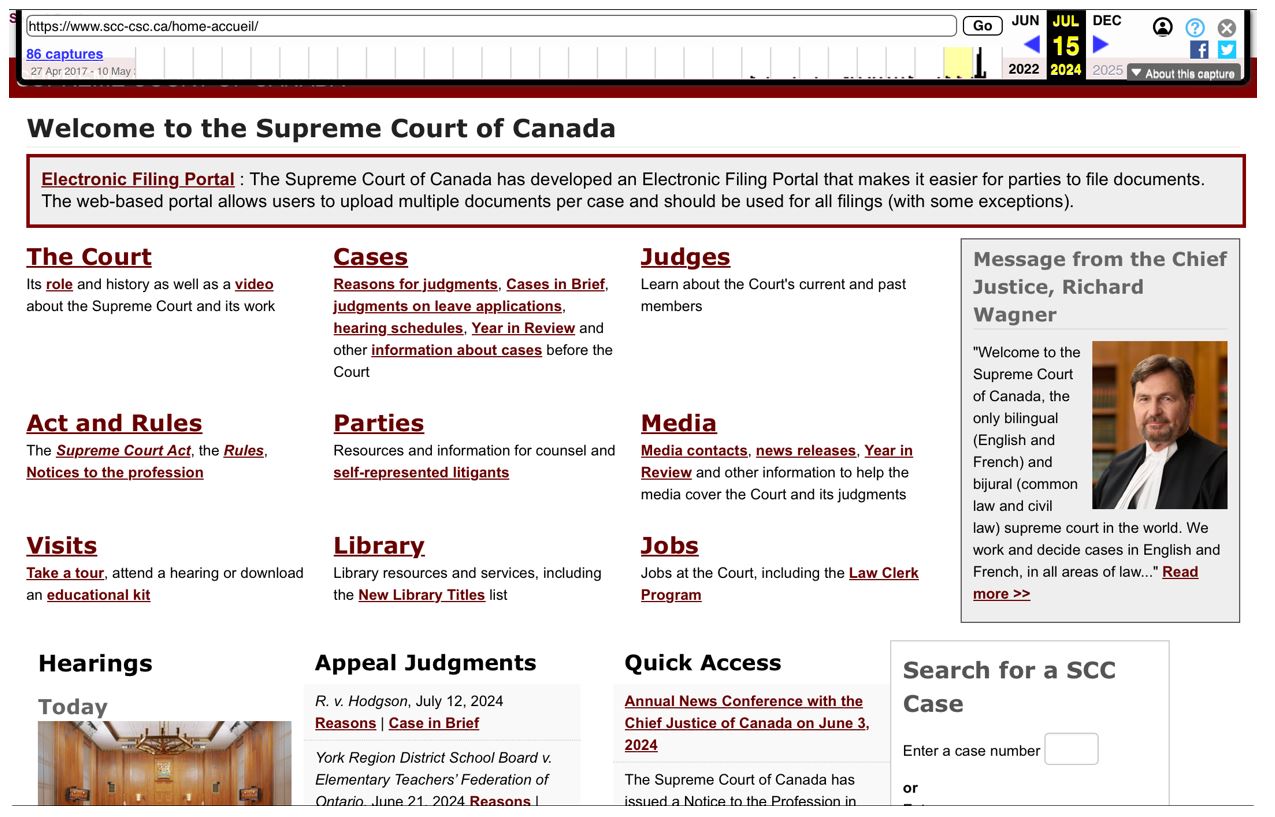
[Screenshot image from iPad: A busy, jargon laden landing page.]

[Screenshot image from iPad (15 May 2025): Improved use of white space, clearer headings, and a more modern aesthetic with bold colours and images.]
Generative AI summaries and analysis have begun to be incorporated into select collections of case law and legislation. For cases, the AI summary includes facts, procedural history, parties’ submissions, legal issues, disposition, and reasons. For legislation the analysis varies, but generally presents an overview and provisional outline of Parts, section headings, and Schedules each being accompanied by a brief description. I assume this feature will continue to expand but this post does not attempt to evaluate their accuracy.

[Screenshot image from iPad (15 May 2025): The new menu of embedded value added case law research tools is displayed in the header. On a desktop/laptop browser it appears to the left of the document.]

[Screenshot image from iPad (15 May 2025): The new menu of embedded value added legislative research tools is displayed in the header. On a desktop/laptop browser it appears to the left of the document.]
The (Potential) Downside
Of course these changes are not universally positive. Simplification, while beneficial for accessibility, can sometimes lead to the concealment of tools or important contextual information.
For a focused example, as previously mentioned, the SCC has added a quick access “Find a Case” link in the header of the main page. However, there is no option to search by case citation or keyword. A use can search only by file number, lower court file number, or case name. To conduct a full text keyword search, which is an important search function depending on the stage of the research process and familiarity with case law research, a user needs to select “Judgments > Canada Supreme Court Reports > Advanced Search > Decisions” or similar route from a different access point. This is cumbersome and may obscure access to judicial decisions.
An AI-adjacent issue with obscured access is that, as generative AI becomes ubiquitous across websites and services, users may experience verification drift. The ability to search by citation and keywords is crucial for verifying the existence and, subsequently, accuracy and relevancy of generated output because the output is often limited to precisely this information, as well as case name. Ensuring these search features remain available will assist in reducing time spent by researchers attempting to verify sources.
CanLII’s inclusion of AI analysis and summaries aligns them with the progress of proprietary platforms (e.g., Lexis+ AI). While it is entirely reasonable to explore how generative AI can and does improve legal research, automation bias should not be overlooked. This happens when we begin to trust the generated output a little too readily, often because it seems easier and more efficient than applying our own judgment—particularly when the tool generating the output is a trusted, reputable resource. Staying mindful of automation bias is important.
As the development of generative AI accelerates and legal research websites and services increasingly adopt modern digital design trends like expansive white space, minimalist iconography, and collapsible menus, there is concern that these redesigns may fail to consider how visual structure might affect human comprehension of legal information. These changes risk reducing legal information systems to being visually appealing but lacking clarity, depth, or transparency in how it is organised or conveyed. These visual changes are modern and user-friendly but may obscure how legal information is structured and linked. When content is reorganised without explanation, researchers may lose important cues about the context or hierarchy of information.
These redesigns may also be preparing platforms for more advanced forms of AI integration, particularly agentic AI.
An Aside to the Upside and Downside
Agentic AI refers to systems that can take autonomous or semi-autonomous action to achieve a goal. Unlike current tools that generate responses to a single prompt, agentic systems can navigate databases, execute tasks, and adapt their strategies with minimal human direction.
To support these capabilities, legal information platforms may undergo backend changes. This could include restructuring metadata and tagging conventions to suit the needs of AI agents. While these changes may improve machine performance, they could make impact human navigation and comprehension of legal information, shifting the way legal information is produced and consumed.
As platforms modernise, it is important to ask who these systems are being optimised for. The decisions made today about design and data architecture will shape how legal information is understood and used in the future.
Positive but Worthy of Pause
Given their timing, I would argue that these recent redesigns represent more than routine maintenance. They are part of a broader recalibration of the digital landscape prompted by the momentum of generative AI. While not all of these legal research websites and services are incorporating generative AI tools, the wider cultural and technological impact of generative AI seems apparent—even institutions not actively deploying AI are finding themselves swept up in the need to modernise to retain value and authority.
Personally, I think most redesigns are net positive and not cause for cynicism, but they do call for continued attention. We should welcome better user experience and improved access to law. But we should also remain critical of the visual, structural, and technological reshaping of legal information that may influence how law is interpreted and applied in the future. This includes the impetus for these changes and the pace at which these changes are happening.

Comments are closed.