

The Friday Fillip: Well-Being

I get a really rather shameful pulse of pride when some organization releases a ranking of nations along one scale or another, showing Canada at or near the top. Shameful, for one thing, because comparisons, even at the level of nation states, are odious (and perhaps also “oderous” as Shakespeare joked). And for another thing because they’re typically based on a combination of loose judgements that would baffle even an expert in Bayseian theory.
Most recently, the OECD has published a Regional Well-Being website:
This interactive site allows you to measure well-being in your region and compare it with 300 other OECD regions based on eight topics central to the quality of our lives.
Here, perhaps trying to dodge the easy patriotism that I’ve referred to, the comparisons have to be between 362 “regions” — which in the case of Canada means provinces — allowing you, for example, to measure Alberta against Belgium’s Vlaams Gewest, if you should be so inclined. (Thirty-four countries are members of the OECD.)
The website is accompanied by a PDF Well-Being User’s Guide, that goes into considerable detail as to the bases used to measure well-being and the statistical means used in their combination. Essentially, the OECD has chosen eight topics to measure, that when combined give an index of “well-being”:
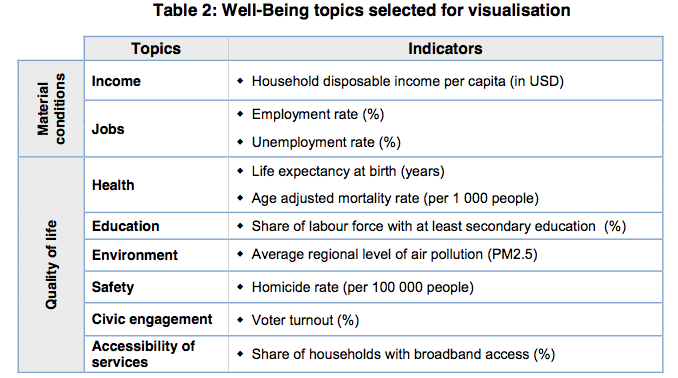
Click on image to enlarge.
Note that well-being isn’t synonymous with happiness or even contentment, two objects of pursuit that are more difficult to measure “objectively” than these eight factors. (Compare these with the ten factors that make up well-being according to the Canadian government.) Thus, for instance, some countries that have a high index of well-being also have a much higher suicide rate than other countries that score low in well-being: Stockholm, for example ( — regions, remember) boasts a score of just under nine out of ten for well-being, whereas Athens comes in at about six out of ten; but Sweden has a suicide rate of 11 per 100,000 compared to Greece at a rate of 2.8. The corresponding numbers for Helsinki and Finland are 8/10 and 17/100,000, contrastingly for Istanbul and Turkey something like 4.5/10 and 4/100,000; for Seoul around 7/10 and a shocking 28/100,000, compared to, for Mexico City and Mexico, ~3/10 and 4/100,000.
Then there’s the fact that the very goal concept as phrased in the English “well-being” — the thing purportedly measured via the chosen proxies — doesn’t always translate easily into other languages. There’s a lovely column in the great Language Log blog on this very problem, exploring the problem of finding the right term in some Asian languages, particularly Korean, where the word, adopted as “wellbing” (sic) [웰빙], has hit the big time and is used to describe all manner of faddish practices, with a focus, perhaps on physical health to the exclusion of other factors we put into the mix.
All of which goes to show that measuring the “good” ain’t easy, coming close to the problem that a friend used to call “effing the ineffable.” Yet, difficult as it is to capture and assess well-being, we’re now aiming to measure that elusive condition, happiness. The UN has released in 2012 a World Happiness Report. (See also a 2013 Report.) And Bhutan, the country that hosted the first UN conference on happiness, has actually adopted a measure called gross national happiness (GNH) to replace its use of the more typical GDP or GNP.
And for you patriots, you should know that Canada dropped from 5th to 6th place in the world as far as happiness goes. So get out there and be happier.

Comments are closed.