Canada’s online legal magazine.

SCOTUS Website Re-Designed

The Supreme Court of the United States has launched a new website. According to their What’s New page:

Welcome to the Supreme Court’s new Website, which not only has a new look, but also incorporates new features, including:

  • recent Court decisions accessible from the homepage
  • docket files dating back to 2000
  • an interactive Court calendar
  • a new case citation finder
  • enhanced search and navigation capabilities

Additonal features and enhancements will be added over time, so watch this space for announcements.

The previous design had been criticized for being out of date with regard to look and content, and was . . . [more]

Posted in: Technology: Internet

Civil Court Survey Statistics

StatsCan has released the data from the Civil Court Survey for 2008/2009 of Nova Scotia, Ontario, Alberta, British Columbia, Yukon, Northwest Territories and Nunavut. The data are available upon request from Statistics Canada’s Centre for Justice Statistics.

Slaw has made that request and has placed the data file we received online for you to download [PDF]. The data are in ten tables for each of the years of the survey, i.e. the years 2005/2006 to 2008/2009. The tables respecting 2008/2009 begin on page 33 of the file. They (and those for the other years) are as follows:

  1. Civil court
. . . [more]
Posted in: Legal Information

European Court of Justice Rules in Google v LVMH

Luxury good maker Louis Vuitton Moet Hennessy (LVMH), who produces Moet & Chandon champagne and Dior perfume, claimed that Google’s advertising polices violated their trademark. The practice in question was the use of key words related to brand names by counterfeiters, who would then link to online stores.

Based on reported coverage of the case, the European Court of Justice made several main findings in a decision released this morning:

  1. Google has not infringed copyright simply for allowing companies to purchase trade mark key words
  2. Google cannot be liable for advertising requests if it removes them when informed that
. . . [more]
Posted in: Substantive Law: Judicial Decisions

Job Postings for Canadian Lawyers on LinkedIn

Amanda Ellis notes that some Big Law firms in the U.S. are using LinkedIn for recruiting lawyers,

I always glance at the jobs section but today was the first day I remember seeing three attorney positions posted by a firm – not to mention a large firm. Usually, the openings in this section include in-house positions and/or legal support positions.

Are more law firms posting attorney job openings on LinkedIn? Possibly. Should law students and lawyers review LinkedIn’s job postings? Absolutely.

Although earlier this month Wendy Reynolds recommended here on Slaw job searchers use LinkedIn, do we have any evidence . . . [more]

Posted in: Practice of Law: Practice Management

This Week’s Biotech Highlights

This Week in Biotech was notable for the passage of comprehensive health reform legislation in the U.S. The bill will have major ramifications for coverage, cost, and insurance markets South of the 49th. It will also have global implications for biotech and pharma companies, shaping two major industry trends:

First, the bill includes a 12-year exclusivity period for new biologic drugs. The EU and Canada have chosen to provide only 6 years’ protection, as discussed in a post on Health Canada’s finalized Guidance Document this week. Because these drugs are complex to begin with, there is a high . . . [more]

Posted in: Substantive Law: Legislation

Preserving the Digital Heritage of Mankind

We haven’t discussed the joint US/UK Blue Ribbon Task Force on Sustainable Digital Preservation and Access which last week published its final report titled “Sustainable Economics for a Digital Planet: Ensuring Long-Term Access to Digital Information”.

This is the most sustained attempt to deal with the long-term problem of data deluge to ensure that researchers and scholars in the future can access our knowledge heritage in the same way that can now be done at the Bodleian or the Library of Congress.

The size of our stock of digital knowledge doubles in less than two years. This is a . . . [more]

Posted in: Legal Information: Information Management

What’s Queen’s Doing to Its Library?

A law library is central to a law school.

Pretty unarguable proposition I would have thought.

Students have to have a library to learn. Faculty to teach and write.

That’s why I can’t understand the story told in the Queen’s Journal this week under the headline Future uncertain for law library.

Like many universities, Queen’s has had to make regular operational budget cuts. But Queen’s isn’t a tiny school and serving the needs of 30 full-time law faculty and about 500 law students, can’t be easily done with the six and a half full-time staff at the Lederman Law . . . [more]

Posted in: Education & Training: Law Schools, Legal Information: Libraries & Research

Google Stops Censoring Chinese Results

As of noon today Google will no longer censor the results of searches with Google Search, Google News, and Google Images on Google.cn. According to the Official Google Blog:

Users visiting Google.cn are now being redirected to Google.com.hk, where we are offering uncensored search in simplified Chinese, specifically designed for users in mainland China and delivered via our servers in Hong Kong.

In introducing this move, Google gave prominence to the attacks on its site within China, and only secondarily referred to “attempts to . . . limit free speech.” As Google points out in this announcement, . . . [more]

Posted in: Technology: Internet

CanLII’s Favicon

For what it’s worth — and it can’t be very much at 16 pixels square — CanLII, the Canadian Legal Information Institute, has a favicon. It may have been up there for months and I’ve only now noticed it, of course. But if so, you may not have noticed it either, so I thought I’d show it to you — at twice the size you’d actually see it at: — rather than that used by the other legal information institutes, AustLII, WorldLII, and BaiLII respectively:

We’ve posted about these inconsequential artworks before on Slaw: Law Firm Favicons, Google’s . . . [more]

Posted in: Miscellaneous

Sample of New Media Coverage of U.S. Health Reform Bill

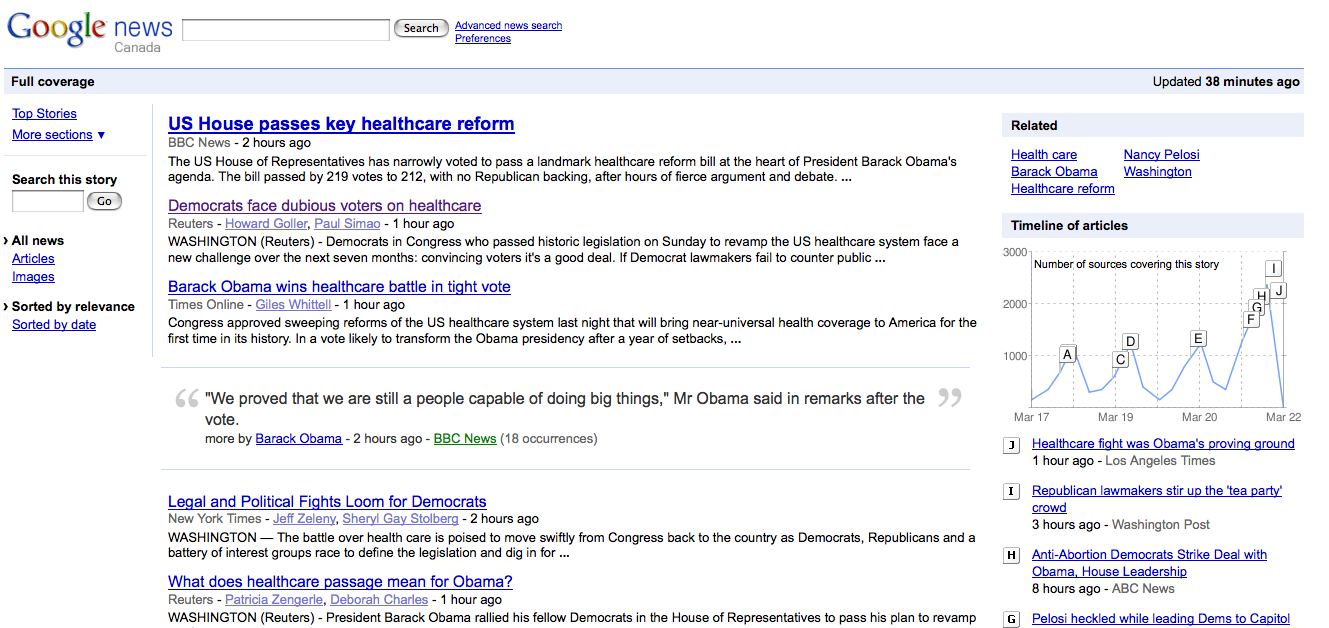
In catching up on the news about the progress of the US health care bill, I was interested in the mix of media that provided the news. Notably, the Google News page on US House passes healthcare reform shows an interesting mix of media (click on image for a larger view):

In addition to news stories from a range of sources, I note the Barack Obama quote pulled out (was this automatically generated after being repeated by numerous sources?), and the time line with list of stories on the right. Scrolling further down on the page reveals additional related photos . . . [more]

Posted in: Substantive Law: Legislation

Social Media on Drugs

Pharmaceutical companies are heavily regulated in the manner in which they can advertise to consumers. And for good reason – drugs are highly effective in addressing medical conditions, but also potentially dangerous when used improperly or interacting with other medications.

The U.S. Food and Drug Administration (FDA) is currently reviewing submissions from the pharmaceutical industry about the use of social media, and is expected to release new rules by the end of the year.

The role of social media in educating the public is something that should not be underestimated. Eric Ruth of the Delaware Online said,

On both sides,

. . . [more]
Posted in: Substantive Law: Foreign Law, Technology: Internet

3li_EnFr_Wordmark_W

This project has been made possible in part by the Government of Canada | Ce projet a été rendu possible en partie grâce au gouvernement du Canada