Podcamp Halifax Coming Soon!
For all the great info including speakers, location and plenty of details, visit:
http://podcamphalifax.ca . . . [more]
Posted in: Uncategorized


For all the great info including speakers, location and plenty of details, visit:
http://podcamphalifax.ca . . . [more]
Announcement today from the Library of Congress: here is the Press Release
The Global Legal Information Network Offers New Features . . . [more]
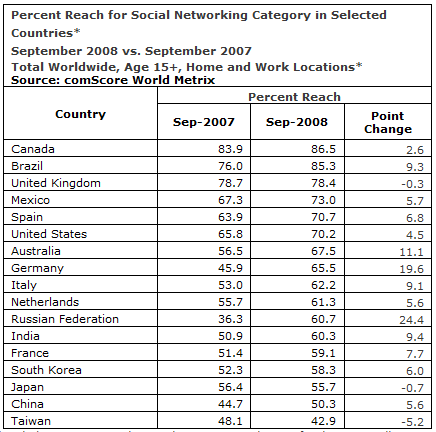
This from our Slaw friend Jim Milles… It seems that a new study from comScore is showing Canada as the number one nation in the world in Social Networking adoption.
Here’s a screen capture of the chart:
. . . [more]
Librarians often debate the prices of law books, wondering why pricing soars beyond normal trade publishing prices. The suspicion is that editorial and marketing costs are not higher than trade costs. Of course one factor is the small size of print runs. Canadian publishers faced with demand for an out of print book (like Bill Estey’s Legal Opinions in Commercial Transactions) will often print just a couple of hundred copies.
Now we’ve actual evidence of a major legal publisher going for print on demand. The costs are, of course, high in relation to page count.
OUP have recently re-issued, . . . [more]
Some background on the current fun and games / constitutional crisis / surrealist psychodrama on Parliament Hill:
And then my head exploded… . . . [more]
RIA Novosti sets up agency providing legal information. Here is the Press Release
MOSCOW, December 3 – The Russian state news agency RIA Novosti has established a law agency to cover new developments taking place in Russia’s legal system, a RIA Novosti deputy editor-in-chief said on Wednesday.
The Agency for Legal and Judicial Information (APSI), set up jointly with Russia’s Supreme Court, Constitutional Court and Supreme Court of Arbitration, is due to begin its work in the near future, Maxim Filimonov said.
The new agency aims to provide objective information on the activity of the courts in an effort to . . . [more]
Two of my favourite blogs, The Court and Michel-Adrien Sheppard (aka Library Boy) come together in this post, which went up today. Michel-Adrien is certainly no stranger to SLAWyers, as he is a frequent contributor to the discussions here. Thanks to Michel-Adrien and the intereviewer for this insight.
I’m sure I’m not alone in my fascination with career path stories – learning how someone else came to be where they are now. The steelworker who is now a systems architect, the former prison guard who is now a lawyer – these stories show just how powerful serendipity can . . . [more]
Speaking of “Shouldn’t it just work“, I have been thinking that a sole practitioner or small firm actually is now at an advantage over larger firms regarding technology.
Software required to run law firms – such as accounting and document management – has typically been created specifically for law firms. That means it is not cheap, and is rarely cutting edge.
But tools are now available that give essentially the same functionality (or at least the 80% that one actually needs) that are low cost and easy to use. Online accounting services for example, or OneNote and search . . . [more]
♬It’s work, the most important thing is work..♬
Words and Music by Lou Reed and John Cale, recorded by John Cale.
I was part of an online email dialogue today on Tablet PC’s. I have long been an admirer of these devices that are closer to a pad of paper than any other computing platform. I liked the idea that you could take out a stylus and start drawing, writing, clicking – rather than being limited to using a keyboard. I felt that this was a positive step in the development of the portable computer. . . . [more]
The Legislation Act, 2006 provided (in section 35) that a copy of a source law or consolidated law is an official copy of the law if accessed from the eLaws website in a prescribed form or format.
The regulation prescribing the form or format has now been filed and published and is effective as of November 30, 2008. A press release from the Ministry of the Attorney General is here.
Section 39 of the Act provides that an official copy is an accurate statement of the law, unless the contrary is proved. For official copies taken from the eLaws . . . [more]
It’s report card time (in Ontario primary schools at least), so why don’t we talk about some client service report cards for you and your firm.
My SLAW post last week was about the importance of keeping your clients happy, and how a post matter client survey (a sample survey is here) is one of the best ways to collect information about what clients thought about the services you provided.
Building on what I said last week, a look in the mirror can help as well. The Managing a Better Professional Services Firm Booklet I mentioned last week . . . [more]
The Federal Rules of Evidence have now been amended to include a new Rule 502 [PDF], which should represent a sea change in the law of waiver in the United States. Rule 502 is intended to introduce uniformity in the law of waiver of attorney-client privilege and work production protection throughout the United States courts and, through operation of the Commerce Clause of the United States Constitution, among State courts.
The problem that led to the enactment of the Rule is the sheer volume and expense that arises from the review of perhaps millions of documents that are “electronic” in . . . [more]

This project has been made possible in part by the Government of Canada | Ce projet a été rendu possible en partie grâce au gouvernement du Canada