

Data Dot Gc

Yesterday the OpenParliament site for Canadians, today an open data site for us. Like its parliamentary cousin, though, DataDotGc.ca is not, alas, a government initiative; rather, it’s the work of a group of private citizens led by David Eaves, a B.C. activist and public policy wonk. As they say on the site:
Unlike the United States (data.gov) and Britain (data.gov.uk), Canada has no open data strategy. This must change. Canadians paid for the information gathered about our country, ourselves and our government. Free access to it could help stimulate our economy and enhance our democracy. In pursuit of this goal, this website is a citizen-led effort to promote open data and help share data that has already been liberated.
What’s on the site? Well, thanks to the tight-fisted government, not nearly as much as there should be. The chart on the main page says it all:
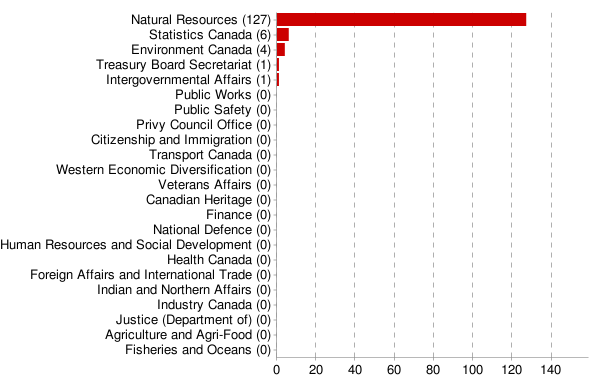
But if it’s freely available, they’ve got pointers to it. The page on “all packages” of data reveals 678 records, such things as “Gold & Silver Mines Energy Use & GHG Emissions” or “Canada Land Inventory (1:50 000) – Land Use (circa 1966)” and “Personal Use Vehicles in Canada: Fuel Consumption Profile.” The links lead to government web pages, where data is made available in various formats. Potential users still must extract the data sets themselves in order to make use of them.
This is clearly a shaming site as well as a demonstration site. As part of a larger open data movement, the site builders are clear about what properly constitutes open data and what they — and government — can do to benefit Canadians:
Open data is a philosophy and practice requiring that certain data are freely available to everyone, without restrictions from copyright, patents or other mechanisms of control. For government data to be open it must, at a minimum comply with three laws of open data. In short:
- If it can’t be spidered or indexed, it doesn’t exist (something this website seeks to help accomplish)
- If it isn’t available in open and machine readable format, it can’t engage (something we hope to help enhance in version 2.0 of this site)
- If a legal framework doesn’t allow it to be repurposed, it doesn’t empower (sadly there is nothing we can do on this front wherever licenses present an obstacle)
Note, law folks, that one of those balls is in our court.

While I realize that this isn’t the same as open data, an excellent resource for Ontario gov docs is the Ontario Legislative Library’s Ontario Government Documents repository. Access to this resource can be made through OurOntario (http://govdocs.ourontario.ca/search) – a search portal prioviding full-text search access to documents in the repository. Alternatively, there is Scholars Portal o-zone (https://ozone.scholarsportal.info/handle/1873/306) ( the Ontario Council of University Libraries archive tool).
The Ontario Legislative Library started building this repository in April 2000 in response to an increasing need to provide persistent access to electronic Ontario government documents. This began modestly as a pilot project to develop the practical sets of procedures required to allow the capture of these born digital documents. It eventually expanded to a stage where a team of cataloguing and acquisitions staff were able to capture, archive and catalogue documents shortly after they are posted on the web, thereby meeting Library client need for access. Documents selected for archiving are based on the Library’s collection policy goal of maintaining an extensive collection that is of value to clients, but also preserves the publishing output of the province and has long-term significance for scholars, researchers, members of the public and public servants.
The Repository now contains some 14,000 monographs and 20,000 serial issues.
(This text supplied by my colleague Peter Ellinger, Manager of Library Technology Applications).