

This One’s About Rock ‘n’ Roll, Comic Books and Bubble Gum

It is unlikely that when Canadian rockers Headstones released the song “When Something Stands for Nothing” in 1993 that they did so as a political comment on the continuing relevance of the Magna Carta to the laws of the United Kingdom and her colonies. So I may have been in alone in thinking of this song when reading a David Allen Green blog post on the Financial Times site entitled “The myth of the Magna Carta”. Mr. Green (lawyer, blogger, author and popular legal Twitterer under the handle @JackofKent) describes the most referenced of the three surviving chapters of the document – Article 29 – as a “wonderful and rousing statement of the rule of law” but one lacking in any practical effect or usefulness.
“…as law, it is of little or no practical use. Nobody in modern times seems to have ever relied on it to determine the outcome of a case. It is not “live” in the way the Bill of Rights is in the United States or similar constitutional guarantees in other countries. It is ornamentation, not legislation.”
He goes on, through his FT and personal blogs, as well as through his Twitter account, to challenge readers to find some example in living memory (or even earlier) where an English court, or a court in a jurisdiction in which received English law forms or has formed part of the law, has treated the words as law, rather than as platitudes or symbols. Lively debate ensues.
I use this example and the song it evoked as a lead in to the point I want to explore: does the phrase “access to justice” stand for something?
As a phrase that appears in around 3,000 cases on CanLII, it must stand for something. But is it like Green’s perception of the Magna Carta: a “wonderful and rousing statement” lacking in practical effect or usefulness? Considering Canada’s “living tree” approach to constitutional and rights analysis, is there even a benefit to codifying its meaning?
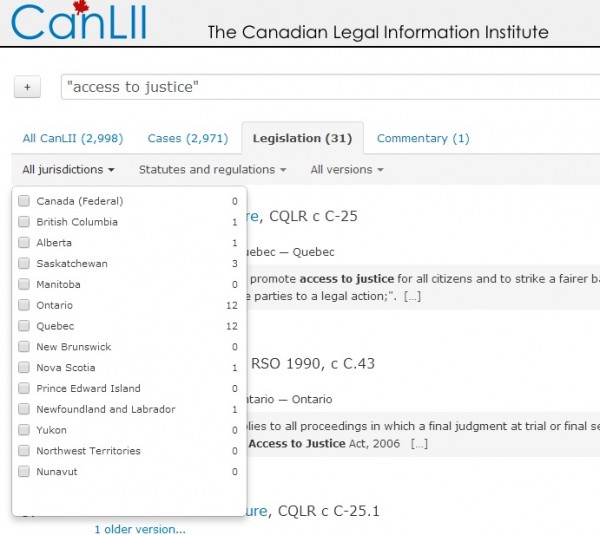
As this picture shows, despite its frequent invocation in the case law, the phrase “access to justice” does not appear in any federal statute or regulation, and outside of Ontario and Quebec it gets scant or no reference at all.
Words matters, but actions matter more
To use an example, the various justice reforms established in Ontario’s 2006 “Access to Justice Act” are more meaningful than the title of the Act that put them into effect. All the more so, because the Act itself was just the vehicle through which amendments to other statutes were implemented. In fact, the Act did not even include any recitals, preambles or statement of purpose or object that would ensure continuing awareness of whatever intent motivated the government to act.
Similarly, failure to use the magic words “access to justice” are not indicative of anything, least of all a lack of commitment to substantive action.
“Access to justice” or “A2J” (or even “#A2J” for digiterati slacktivists – a group in which I admittedly participate from time to time) is a useful form of shorthand or code among like-minded and similarly-informed people, but in the absence of action, it is also a platitude.
At the risk of exposing my association of topics and song selection as lacking coherence, I’ll leave the last word and inspiration to the lyrics:
And each day offers something
But none of it’ll last
Unless you take the reins
Take them from the knight
Push the pawn
Right through the pass
And this one’s for the silence
And the questions that it brings
And the smell of time
And the reverence
And the possibilities
Double up the foreground
Put it on a slide
Inspect it with your perfect ways
Until it burns your eyes
And this one is for nothing
This one’s for fun
And this one’s about rock ‘n’ roll,
Comic books and bubble gum

Comments are closed.