WestlawNext Consolidates
Back in the winter, we unveiled the new features that Thomson / West’s boffins have been dreaming up to soup up Westlaw for a Google-impatient generation.
A few notes from Eagan. . . . [more]


Back in the winter, we unveiled the new features that Thomson / West’s boffins have been dreaming up to soup up Westlaw for a Google-impatient generation.
A few notes from Eagan. . . . [more]
I had occasion recently to take a look at Canadian Technology & IP Law, a blog put out by Stikeman Elliott. Their IP practice area page says the blog is new, but I was surprised to see that it’s been in existence since March of 2008: in all the time between then and now there have been a total of 40 posts, which is an average of something less than one entry every two weeks. There have been bursts of activity, from time to time; but dry spells have persisted as well, right up to the present: one . . . [more]
How can we reduce our workloads, and do the more interesting knowledge work? In his April 15th presentation “The Nature of Knowledge Work” Keith D. Swenson, VP of R & D for Fujistu America defined knowledge work as:
Presumably, then, all other work done by knowledge workers is information work. It is work that is repeated, predictable, routine or otherwise fairly straight-forward.
This is not a new consideration. We have been good at ensuring the repetitive or predictable work is given to people at more junior levels so . . . [more]
(And anybody else who cares to participate)
The assumption around here is that Slaw is the most widely read, or at least one of the most widely read law blogs, amongst lawyers (academic and practicing), judges, and others associated with the profession. I’m going to (try to) put that to the test.
As some of you know, my particular (legal) research interest is factual causation in tort, particularly negligence. I’ve described that interest, on occasion, as the search for the “f” in actual cause.
I pose this question for those of you involved in civil litigation.
Are you prepared to . . . [more]
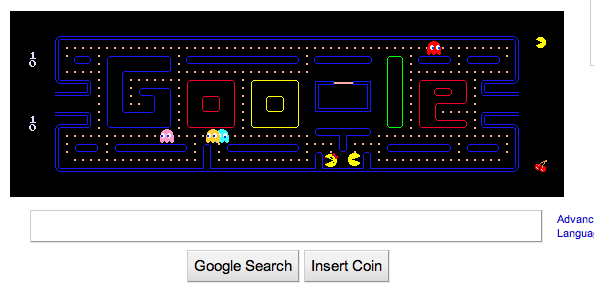
If you haven’t used Google today, do it. The doodle right now is a PAC-MAN game, to celebrate the 30th birthday of that cultural event. And it works! Click on “insert coin” and use your arrow keys to eat your way to victory!
. . . [more]
Sandra’s office was piled high with files, her work-life was spent putting out fires and her dog was feeling so neglected it had taken to chewing the couch.
Jeremy felt like it had been a long time since he had a life. Days and weekends were spent at the office, he’d gained 20 pounds in a year, and his wife had gone on vacation to Mexico with her best friend Gary the hairdresser – again.
Sandra and Jeremy are not alone. These days it seems like the standard answer to “hi, how are you?” has become “busy, and you?” Having . . . [more]
After much stalling and anticipation Ontario has finally enacted a formal ignition interlock program designed to relieve some of the burden on our courts caused by massive amounts of impaired driving litigation.
Effective Aug. 3, 2010, persons convicted of a first impaired driving offence that does not cause bodily harm or death will be eligible for reduced licence suspensions if they comply with the regulations of the program — the primary requirement being the installation of an ignition interlock device (essentially a mini-breathalyzer machine attached to the ignition of your vehicle making it impossible to operate the car unless sobriety . . . [more]
Of all the world’s familiar objects few are as recognizable as the red, London double-decker bus. And the prince of these — for there have been variations on a theme here — is the Routemaster pictured below.
Recognizable by its distinctive half cab and by the hop-on-hop-off back door, the Routemaster served London from the mid fifties until December 9, 2005, when the very last of the scarlet behemoths was taken out of service.
London Mayor “Red” Ken Livingstone presided over the demise, but five years later Tory blue Mayor Boris Johnson decided that they were wanted again and so . . . [more]
The title of this posting is the title of an article that just appeared on the Chronicle Review website of the The Chronicle of Higher Education.
Call it a more temperate look (more temperate than that of a now retired Canadian law professor – already noted on this forum) at law school education, albeit in the United States rather than Canada.
The focus of the article is the education of the graduates from “elite” law schools in the U.S. “at a time when most of the more-radical members of the faculty had either already disappeared or were losing their . . . [more]
We often bemoan that lawyers don’t take seriously their duty to understand e-discovery. Today we tackle another subject that attorneys seem to avoid, often to their peril as they step on virtual cow pies. Social media is so pervasive that ignoring its legal implications is (we think) simple incompetence. Now that the active Facebook user population is more than 400 million globally (more than the U.S. population), it is clear that the social media phenomenon is here to stay.
Not only do lawyers need to understand the upsides and downsides of social media for their clients – they need to . . . [more]

This project has been made possible in part by the Government of Canada | Ce projet a été rendu possible en partie grâce au gouvernement du Canada